I’ve always loved books and bookstores. There are many many blog posts dedicated to my favourite books and bookstores. One dream I’ve had, since graduating five years ago, is to open my own bookstore.
It’s easy for me to get lost in dreams about what the store would look like, what sort of books and other bookish products I would stock, bookish events I would host. My dream bookstore would be a haven for book lovers and authors alike. But, unfortunately, it is but a dream.
Newmarket, my hometown, used to have an independent used bookstore, but it closed YEARS ago. Since, there haven’t been any other bookstores other than the big chain. It’s a real shame because all towns deserve a real cozy bookstore. I’ve been to many, all over the world even, and it’s an experience I adore.
But, it’s expensive to open a brick-and-mortar store. So how could I reconcile my dream with realistic finances?
An online store!
Every single step of this process has been surprisingly painless. From registering the business with various governmental bodies, finding the best hosting platform, and collecting initial stock. It’s also been much cheaper and much less risky.
But, more importantly, I’ve been able to do something I’m passionate about. Yes, I don’t get to design a real shop where I can put a homey reading nook. And I don’t get face-to-face interactions with my customers. But, it’s better than not doing anything at all.
I set up a couple avenues of direct communication, where customers can contact me and hopefully we can build a real relationship.
A potential customer can email me with a specific book they’re looking for and I’ll find it and ship it to them.
I also provide recommendations for anyone who gives a couple details of their reading habits/preferences
This launch is a wonderful mixture of excitement and terror as I make my dreams a reality and pray that it doesn’t just fizzle out into nothing.
Yin-yang fried rice was a feast for the eyes and the senses. Swirls of cream contrasted with an orange tomato sauce to form the iconic pattern. Underneath the sauces lay a bed of yang chow fried rice containing a bounty of minced jewels: barbecued pork, Chinese sausage, peas, carrots, spring onions, and wisps of egg. Slices of white onions and pork emerged from the tomato sauce while shrimp and sweet green peas decorated the cream.
At the news of her mother’s death, Natalie Tan returns home. The two women hadn’t spoken since Natalie left in anger seven years ago, when her mother refused to support her chosen career as a chef. Natalie is shocked to discover the vibrant neighbourhood of San Francisco’s Chinatown that she remembers from her childhood is fading, with businesses failing and families moving out. She’s even more surprised to learn she has inherited her grandmother’s restaurant.
The neighbourhood seer reads the restaurant’s fortune in the leaves: Natalie must cook three recipes from her grandmother’s cookbook to aid her struggling neighbours before the restaurant will succeed. Unfortunately, Natalie has no desire to help them try to turn things around–she resents the local shopkeepers for leaving her alone to take care of her agoraphobic mother when she was growing up. But with the support of a surprising new friend and a budding romance, Natalie starts to realize that maybe her neighbours really have been there for her all along.
I don’t know quite where to start with this one except that it’s deliciously good.
Roselle Lim’s wonderful descriptions of the food cooked throughout the novel left me reaching for a snack. At times I could almost smell the meals wafting from the pages of the book.
Along with the food descriptions, the setting of San Fransisco’s Chinatown completely encased me. Lim has painted such a clear picture, it was hard not to feel like I’d travelled the great distance between my home in Ontario to northern California. I could fully imagine the neighbourhood where Natalie moved back to along with the delightful cast of characters.
Each one of the characters in the book felt so real and grounded in reality. From the intimidating and somewhat grumpy restaurant owner to the down-on-her-luck shop owner, I felt like I could just walk out the door and meet them on the street. And I’d want to. Despite some obvious conflicts, no character was completely unlikeable or unredeemable. It was so nice.
Right now the world is in a bit of chaos, and books like this are much needed. This book is like curling up inside a warm pork bun (wouldn’t that be amazing, though?). Though this is what I could call a “comfort book” and I knew everything would work out in the end, I still felt very much compelled to read on and on. I laughed and I cried in equal measure.
I won’t give anything away because you should do yourself a favour and read this book, but there’s a twist that took me by surprise. It was the happy little cherry on top of this delicious book sundae.
Just over two weeks ago, I finished writing the first draft of my current work-in-progress. I feel satisfied with this draft. I wrote it in under a year, whereas the last one took over two years, and I felt more naturally creative while writing. What’s so different about this one, compared to my first novel, is that I wrote it all by hand in a notebook.
So, I’ve decided that I’m going to write all of my first drafts by hand.
Flow, creativity, flow
The big issue I find with writing is my incredibly short bursts of creative energy. Usually, I can write in a somewhat-halting sprint for like 10 minutes before I get distracted by something else on the computer or my idea sputters out.
When writing in a notebook, I was able to write for longer and I found my creative energies didn’t run out nearly as quickly. My writing sessions lasted longer and I found the ideas came more organically as I went. And not working on a computer removed those dastardly distractions.
The best thing about writing the draft by hand in a notebook was, if I had a moment of inspiration, I could write it down no matter where I was. I’d take the notebook to work with me, and in quiet moments between clients, I could scribble down the next scene. I didn’t need to get into a creative mindset, like I do on the computer, I could tap into my inspiration whenever I needed it.
Word counts are a lie
Okay, that’s an exaggeration. If you enjoy having a word count goal, more power to you, but I found I worked best without one.
Handwriting meant I couldn’t keep track of my word count unless I wanted to sit and count it out… which sounds like no fun at all. But the lack of word count tracking gave me a certain freedom I never felt on the computer. It was just one less thing to worry about.
Instead of making sure I was hitting goals, I was able to fully focus on the story. The characters and plot were in control, not some arbitrary number. And any time I did think about my word count, it was more out of curiosity. How many words had I written?
I found my voice
Maybe this isn’t something directly related to handwriting my novel, but it’s something I noticed while I was writing. My writer’s voice came out.
When I was writing my first book, I had this nagging feeling the whole time that the writing was bland. While some passages were quite good in my opinion, I think my instincts were right. I hadn’t developed my own unique voice.
This time was different, and, as I said, I don’t know if it was the handwriting or just my own growth as a writer, my writing voice came out. The prose is distinct and adds to the atmosphere of the book, rather than just being words that describe what’s happening.
The reason I suspect it might be related goes back to the natural way in which the words seem to flow. The overthinking and habitual distractions weren’t present, so the voice could come out unhindered.
Editing is for the second draft
I wrote about this before, but handwriting seemed to quiet my inner editor. There was not much I could do after writing a scene but take note of something I wanted to be changed. I couldn’t fixate on it or waste time trying to get it right the first time.
A first draft doesn’t have to get it right. That’s what editing is for. But editing should be saved for after the first draft is complete.
I found when I was writing my first draft of my first book that allowing myself the freedom to edit as I went cut off the “flow” of the story. I’d get disconnected from what was happening with the characters, too focused on making sure the writing was perfect.
Now I have a complete(ish) story with full character arcs. The writing isn’t perfect, but at least it’s all there. Getting it from the notebook onto my computer has been acting as a first-pass edit to make sure all the scenes and characters are fully fleshed out before I delve into the heavy-duty editing.
Drafting was actually fun
My first novel was an important step in my writing life, but I didn’t have much fun drafting it. I was too caught up in the pressures of making sure it was “The Book” because I was so sure it was going to be published. Ha!
This time, I’d found a story that I wanted to tell⎯a story with a great amount of heart in it, and I let the passion fuel the drafting process. And it was fun.
New ideas were exciting, connections I made within the plot were deliciously clever, and sitting down to write didn’t feel like a chore. Because I was writing freely, in a way that felt natural to me, the pressure didn’t seem to be so important anymore.
Yes, I wanted the book at the end to be publishable, but the process felt so much more like me, so I let myself relish in it.
If you, like me, were/are struggling to get into the groove, maybe try a different method. Most writers hoard notebooks like dragons, don’t they? At least I do. It’s a simple method and doesn’t require any technology, besides a pen.
Of course, the way I write won’t be exactly right for everyone. Every writer needs to find their own unique process. But this experiment has been a success for me.
I feel like I’m prefaced so many thoughts and sentences with the phrase: “with everything that’s going on…” But, it’s no less relevant or true. So many things are happening everywhere and it’s impossible not to be affected by it.
This is the time of month when I would share the list of books I’m reading at the moment, but I think this one needs to be different. Especially with everything that’s going on right now.
I’ll be the first to admit that sometimes my reading list is not the most diverse. It’s certainly not on purpose, but in the past, I haven’t made a concerted effort to be inclusive and diverse in my reading choices. All the protests and activism and sharing of resources and information have acted as a bit of a wake up call for me. So, starting now I’m making a commitment to read more diverse authors and diverse stories.
Better late than never, right?
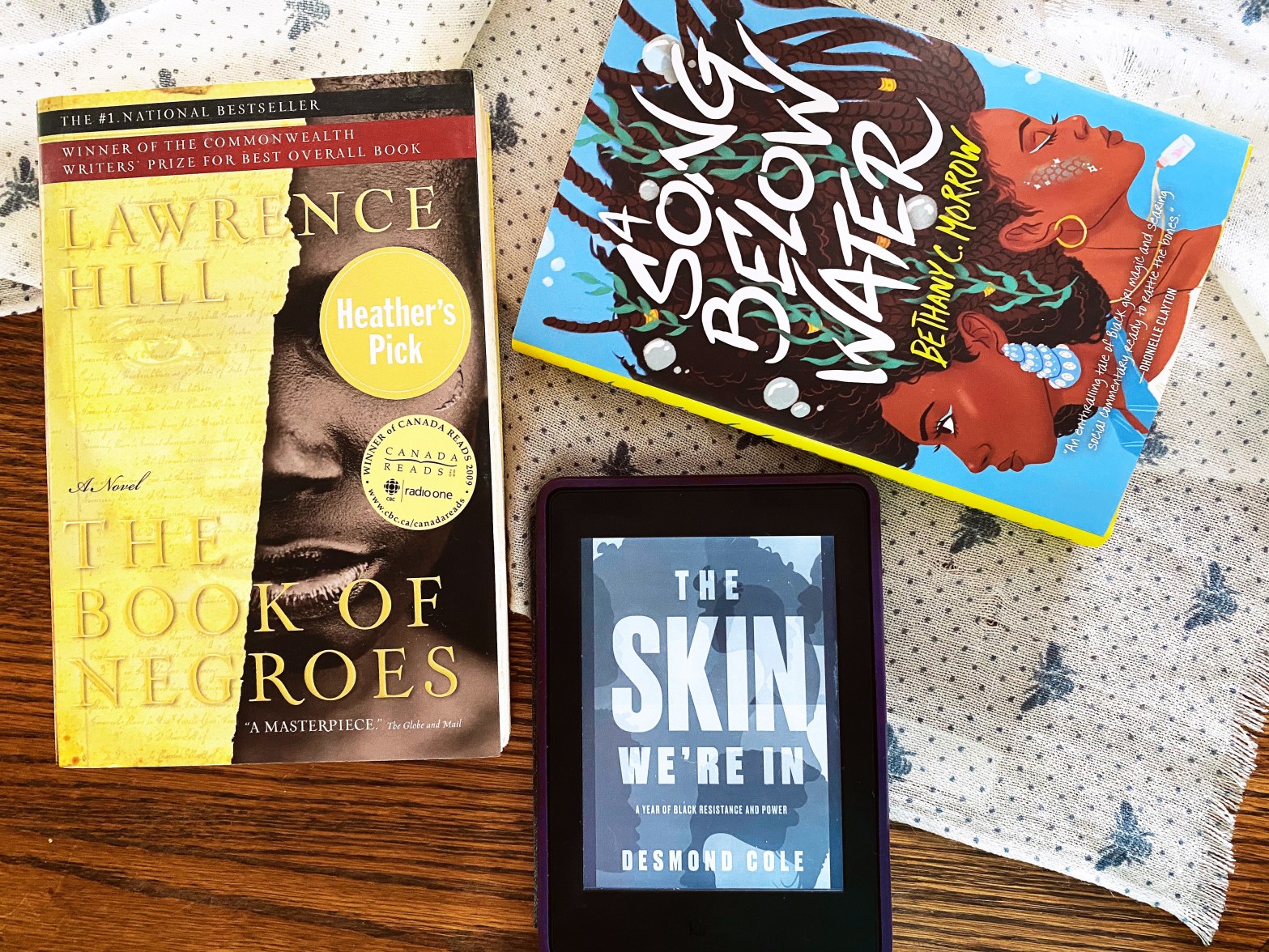
So that leads me to this post. I wanted to do something that highlights and amplifies black voices, both fiction and nonfiction. I’m not including my thoughts this time, just the blurbs from their Goodreads pages so you can fully know and understand what the book is about. This is the list of books I’m currently reading or will be reading in the near future…
In 2014, award-winning journalist Reni Eddo-Lodge wrote about her frustration with the way that discussions of race and racism in Britain were being led by those who weren’t affected by it. She posted a piece on her blog, entitled: ‘Why I’m No Longer Talking to White People About Race’ that led to this book.
Exploring issues from eradicated black history to the political purpose of white dominance, whitewashed feminism to the inextricable link between class and race, Reni Eddo-Lodge offers a timely and essential new framework for how to see, acknowledge and counter racism. It is a searing, illuminating, absolutely necessary exploration of what it is to be a person of colour in Britain today.
A bracing, provocative, and perspective-shifting book from one of Canada’s most celebrated and uncompromising writers, Desmond Cole. The Skin We’re In will spark a national conversation, influence policy, and inspire activists.
In his 2015 cover story for Toronto Life magazine, Desmond Cole exposed the racist actions of the Toronto police force, detailing the dozens of times he had been stopped and interrogated under the controversial practice of carding. The story quickly came to national prominence, shaking the country to its core and catapulting its author into the public sphere. Cole used his newfound profile to draw insistent, unyielding attention to the injustices faced by Black Canadians on a daily basis.
Both Cole’s activism and journalism find vibrant expression in his first book, The Skin We’re In. Puncturing the bubble of Canadian smugness and naive assumptions of a post-racial nation, Cole chronicles just one year—2017—in the struggle against racism in this country. It was a year that saw calls for tighter borders when Black refugees braved frigid temperatures to cross into Manitoba from the States, Indigenous land and water protectors resisting the celebration of Canada’s 150th birthday, police across the country rallying around an officer accused of murder, and more.
The year also witnessed the profound personal and professional ramifications of Desmond Cole’s unwavering determination to combat injustice. In April, Cole disrupted a Toronto police board meeting by calling for the destruction of all data collected through carding. Following the protest, Cole, a columnist with the Toronto Star, was summoned to a meeting with the paper’s opinions editor and informed that his activism violated company policy. Rather than limit his efforts defending Black lives, Cole chose to sever his relationship with the publication. Then in July, at another police board meeting, Cole challenged the board to respond to accusations of a police cover-up in the brutal beating of Dafonte Miller by an off-duty police officer and his brother. When Cole refused to leave the meeting until the question was publicly addressed, he was arrested. The image of Cole walking out of the meeting, handcuffed and flanked by officers, fortified the distrust between the city’s Black community and its police force.
Month-by-month, Cole creates a comprehensive picture of entrenched, systemic inequality. Urgent, controversial, and unsparingly honest, The Skin We’re In is destined to become a vital text for anti-racist and social justice movements in Canada, as well as a potent antidote to the all-too-present complacency of many white Canadians.
Fiction
*Note: I think reading fiction is just as important for gaining perspective and connection as reading Anti-Racist non-fiction, which is why I’m including more in this section.
Tavia is already at odds with the world, forced to keep her siren identity under wraps in a society that wants to keep her kind under lock and key. Never mind she’s also stuck in Portland, Oregon, a city with only a handful of black folk and even fewer of those with magical powers. At least she has her bestie Effie by her side as they tackle high school drama, family secrets, and unrequited crushes.
But everything changes in the aftermath of a siren murder trial that rocks the nation; the girls’ favorite Internet fashion icon reveals she’s also a siren, and the news rips through their community. Tensions escalate when Effie starts being haunted by demons from her past, and Tavia accidentally lets out her magical voice during a police stop. No secret seems safe anymore—soon Portland won’t be either.
They killed my mother. They took our magic. They tried to bury us.
Now we rise.
Zélie Adebola remembers when the soil of Orïsha hummed with magic. Burners ignited flames, Tiders beckoned waves, and Zélie’s Reaper mother summoned forth souls.
But everything changed the night magic disappeared. Under the orders of a ruthless king, maji were killed, leaving Zélie without a mother and her people without hope.
Now Zélie has one chance to bring back magic and strike against the monarchy. With the help of a rogue princess, Zélie must outwit and outrun the crown prince, who is hell-bent on eradicating magic for good.
Danger lurks in Orïsha, where snow leoponaires prowl and vengeful spirits wait in the waters. Yet the greatest danger may be Zélie herself as she struggles to control her powers and her growing feelings for an enemy.
Based on a true story, “The Book of Negroes” tells the story of Aminata, a young girl abducted from her village in Mali aged 11 in 1755, and who, after a deathly journey on a slave ship where she witnesses the brutal repression of a slave revolt, is sold to a plantation owner in South Carolina, who rapes her. She is brought to New York, where she escapes her owner, and finds herself helping the British by recording all the freed slaves on the British side in the Revolutionary War in The Book of Negroes (a real historical document that can be found today at the National Archives at Kew).Aminata is sent to Nova Scotia to start a new life, but finds more hostility, oppression and tragedy. Separated from her one true love, and suffering the unimaginable loss of both her children who are taken away from her, she eventually joins a group of freed slaves on a harrowing odyssey back to Africa, and ends up in London as a living icon for Wilberforce and the other Abolitionists. “The Book of Negroes” is a pageturning narrative that manages to use Aminata’s heart-rending personal story to bring to life a harrowing chapter in our history.
Of course, this is a tiny amount of the books by black authors out there. But, hopefully this gives you a jumping off point for your own more diverse reading list, as it is for me.
If you’d like a more extensive list of anti-racist books, the UofT library released a fairly decent list. Take a gander if you’d like. And there are so many more lists like it you can find everywhere now. Just a wee bit of Googling will get you there.
Happy reading!
P.S. Not all of the books on this list are pictured because a) they’re on the Kindle or b) they haven’t arrived in the mail yet.
Could a coming-of-age or finding-yourself narrative still apply to me?
At 27-years-old I still feel like I’m solidifying my identity, I’m still filled with self-doubt, I’m still trying to find my place in the world. The internal struggles I’m facing in my late (-cringe-) twenties aren’t actually that much different from what I struggled with in my late teens or early twenties. I suspect my youthful ignorance actually left me feeling more confident about my abilities/identity than I feel now.
When I think of adult genres, especially contemporary or literary fiction, I think of characters who are established in their careers, perhaps they have some love troubles, but their life seems to be fairly settled until the events of the novel stir things up a little.
But where are the messy twenty-somethings? What about the people who still need to do a little⎯or maybe a lot⎯of soul-searching?
This is what my most recent book kind of deals with. My protagonist is a 22-year-old who’s never taken a risk and thinks herself satisfied with her quiet existence, though she secretly is terrified of mundane existence and wishes for some magic. In essence, her life needs a wake-up call and for her “real” life to start, she’s going to need to find the magic in herself.
I know this story. It’s an over-exaggeration of my own inner struggles. And I can’t be the only twenty-something who feels this way. Could I?
I’ve received feedback from two other writers who suggested my book might work better as a MG (middle grade). It’s not a completely ridiculous suggestion; the writing is fairly whimsical and it’s a fantastical adventure story with magic books and antique clocks.
But, why do kids ages 8-12 get the monopoly on whimsical fantasy stories?
I know there are YA/Adult aged stories with a whimsicality and lots of magic… Neil Gaiman, Alice Hoffman, and Dianna Wynne Jones have done it. And I’d like to do it too.
Maybe I’m mistaken, but I feel like there’s this idea in the YA genre that a book has to be dark, gritty, and tough in order to be good. At least, that’s what I’ve noticed with a lot of popular YA books in the last 5-10 years. With the immensely popular Hunger Games series and the Shadow Hunters and books where everyone is a fairy assassin or at least a little murder-y.
Could there be space in there for a slightly lighter⎯though still a tiny bit murder-y⎯fantasy book?
I think so.
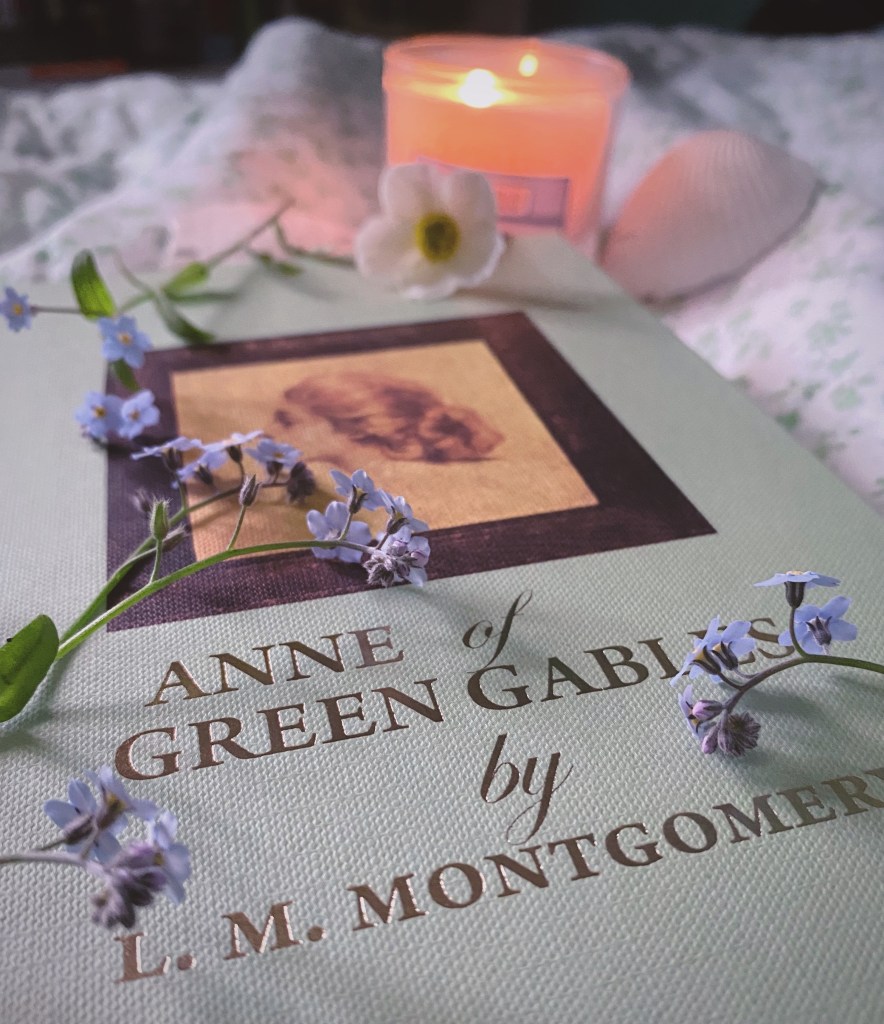
There’s a reason books like Alice in Wonderland, Anne of Green Gables, The Hobbit, and many others like it are still enjoyed today by all ages. There’s a timelessness to them and a desire, perhaps, for a little bit of light and whimsy to contrast with harsh realities.
Sure, Alice in Wonderland is a kids book, but it’s not just enjoyed by children. Anne of Green Gables was, in fact, not written with children in mind, though the writing is quite whimsical and the subject matter is light and happy.
So I’m not going to age-down my novel because I see no need for it.
Maybe my book won’t fit with what’s trendy right now, but I love it. I enjoy the lightness of the writing style and the fact that my main character isn’t angry all the time and wants to kill everyone that looks at her funny.
Let me have my whimsy. I think the world needs more of it!
… That was a lot of the word “whimsical” in one post.”
“Books are good company, in sad times and happy times, for books are people – people who have managed to stay alive by hiding between the covers of a book.” – E.B. White
It may come as no surprise, especially if you’ve been around my blog a while, I like books. A lot. A lot a lot.
I like books so much that many of my life choices have been based around them. I studied English Lit. and History in University for the books and reading. My life goal is to become a published author.
Even if I don’t actively read a book on any given day, there is a good chance that I’ve thought about or passively looked at a book. In the last couple days, I had a conversation with my dad about how I dreamed of expanding the bookshelves in my bedroom to accommodate a bigger library. The dream was dampened by my desire to have wall space for artwork, but the desire to have a big library is alive and well!
Right now, books are a life raft in the sea of chaos that is the world right now. They provide a much needed escape from reality as well as a chance to learn and grow with all the new-found free time.
But my love affair with books began long before this crisis and even before university. There were always books in my house growing up and I remember being read Goodnight Moon before bed. In fact, I was read to sleep well into my childhood. That comes from having two delightfully nerdy parents.
As a kid growing up from the late 90s-mid 2000s, I was in the midst of the Harry Potter bonanza. While I never did a midnight release party, I was an avid reader of all of Harry’s adventures. I’m fairly positive I would’ve continued to be a reader without the Harry Potter books, but they certainly solidified my bookish existence.
Books have always been an escape for me. I’ve always had an active imagination and a sensitive, high-strung spirit. So the hum-drum of life, especially as a somewhat sheltered child, seemed somewhat unsatisfactory. Where were the adventures? Where were the extraordinary people? Where was the magic? In books.
The fact that magic (the Harry Potter, bibitibopityboop kind) was created in someone else’s imagination and actually wasn’t real left my little soul so disappointed. But growing up has dampened that disappointment some, though I never get tired of escaping into books for a good dose of magic.
And I’ve found there’s magic in real life… if you know where to find it.
Anyway, I was a fairly quiet teenager with a small circle of friends, so books remained a constant even as I drifted away from childhood interests. Vampires were the craze during my high school years⎯thanks, Twilight⎯and I’m a bit embarrassed to admit that I ONLY read books about vampires for a while. But, reading Twilight as a shy twelve-year-old continued to reinforce my literary habits. And I’m not the only one who’ll admit that there was something weirdly addicting about those books.
English had always been my best subject, because⎯you know⎯reading, so it seemed like a natural choice to go to university for English. Though, at this point I had also decided I wanted to be a writer and English seemed like a good way of building up my skills in that respect as well. With a double major in English Literature and History, I was set for 4 years of reading and books.
More so now that I’m out of school, I’ve realized that books are so much more than simply and escape. Without the structure and resources of school, books are the next best learning tools.
In the last couple years I’ve discovered how much I want to learn and grow as a person. It sometimes makes me regret not continuing on to a Master’s program or beyond, but then I remind myself that the world is full of easily accessible and sometimes completely free ways of learning: books.
Isn’t that wild?
The only flaw I have is that I’m too excited to read things and I always end up reading 5+ books at a time, which leads to me only finishing books after months of reading. While I’ll never be someone who can read 100 books in a year, I do enjoy seeing how many I can get read. This year, I’m aiming for 35.
Books make up such a large portion of my life as a writer and someone who simply enjoys reading, I even have a dream of one day opening a used bookstore. Despite Amazon taking over and killing all the independent bookstores, I truly believe that there will always be a place for bookstores. People will always need books and people to sell them. Faceless corporations can only do so much. But I will not turn this into a rant about my hot/cold relationship with Amazon.
I could probably write a whole small book one why I think books are amazing and why the written word is so important, but I’ll suffice with this little blog post.
Do me a favour today: pick up a book, even for five minutes. And next time you need to purchase one, consider an independent bookstore (or at least an online bookseller that’s NOT Amazon).
May has been a bit of a blur. It felt like the month only started yesterday, but here we are over half-way through already. I guess time flies when you’re in government-mandated social distancing?
But the silver lining is that I still have lots of time for reading. Though⎯somehow⎯I’m still reading at my usual snail’s pace. Maybe one day I’ll actually read a book within the month that I started it, but today is not that day.
As per usual, I’m reading a bunch of different books. I’m proud of my genre distribution lately, as I’ve not just settled into my usual default fantasy books or Anne of Green Gables. One goal I had for my reading habit was to branch out more into different genres, especially some nonfiction. And what’s my favourite genre of nonfiction? Books about books!
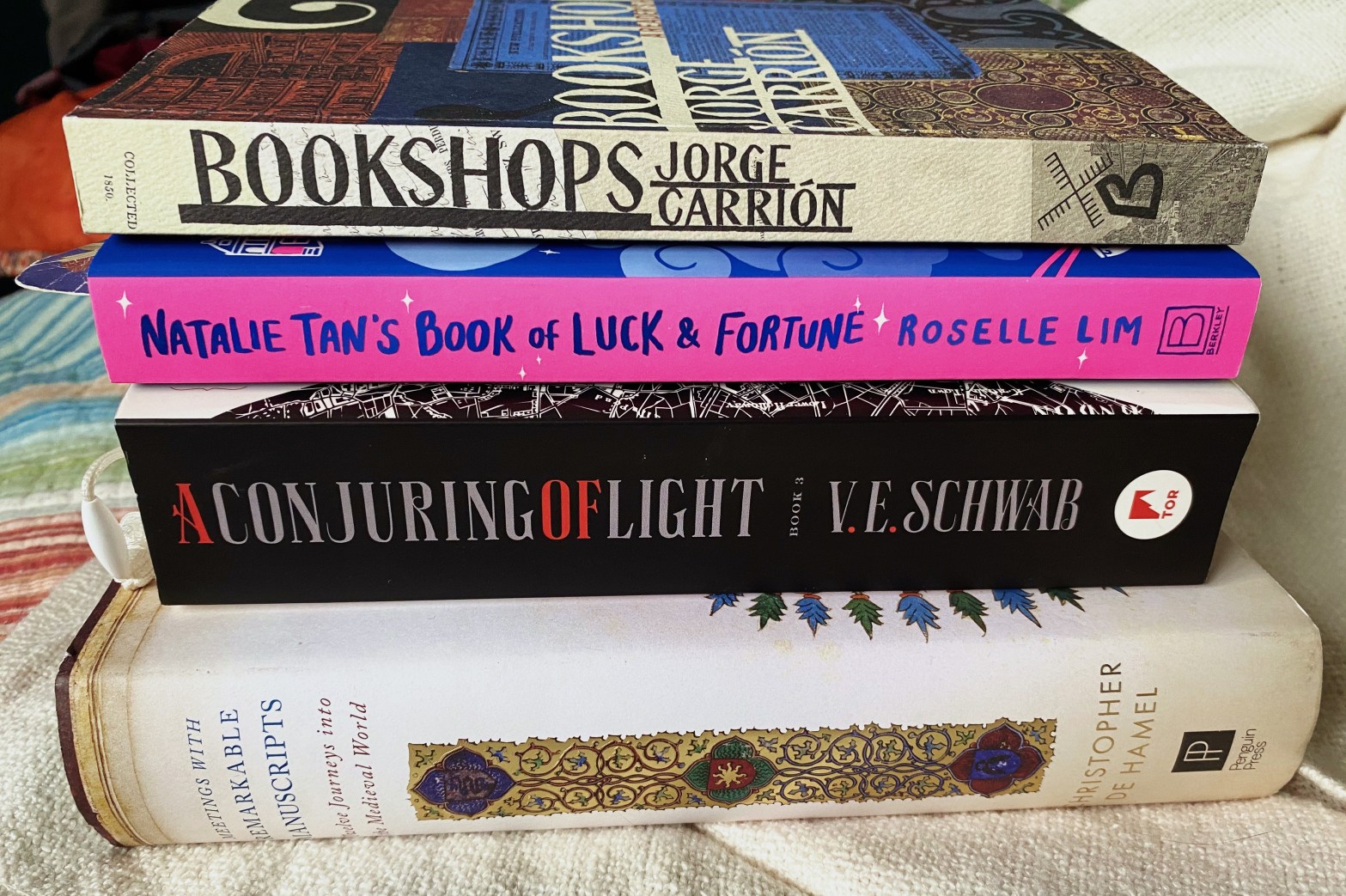
This tome sat on my wish-list for a while before it was very kindly gifted to me. Then it sat almost reverently on my shelf until I picked it up recently.
You can probably guess from the title, but it’s a book about twelve historically significant Medieval manuscripts. The reader is taken on a journey to where the manuscript itself is held and allowed a glimpse into the world of historical writings, where not many but a select few get to go.
This book is one big geek fest for me, as someone who studied medieval history and literature and just LOVES books. I can’t get enough. Just the descriptions are enough to send my geeky heart aflutter.
I highly recommend this book if you love medieval things, especially books!
This is the final book of the Shades of Magic trilogy and, quite predictably, I’m a mixture of sad and excited. I’m very much looking forward to see how the book ends but I also don’t want to get there because that means the series will be over.
Very much like the second book, which I read in April (and actually finished in April), I’m continuously wowed by how much I simply enjoy the story and the characters. Of course, I have a big bias towards the fantasy genre in general, but this series had all the things I never knew I needed in my life.
Roselle Lim is a Canadian writer who I follow on Twitter and Instagram because I just love supporting my fellow Canadian women writers. When I first followed her, this book wasn’t out yet, so I watched with eager eyes as the book went through its final stages of being published. And to continue to support my fellow writer, I picked it up the day it came out.
Then it sat on my shelf⎯like most books I buy do⎯until I finally decided that it was time to read it. After a year and a half. Sorry, Roselle.
One word of caution for those who read this book (and you should): don’t read it while hungry! It’ll get so much worse! This sweet book is so full of delicious sounding recipes and food descriptions that I always come away with massive cravings.
Despite leaving me feeling like I need to hire a personal chef to cook me some amazing food (because god knows I can’t), I’ve been heartily enjoying this story about love, loss, and rediscovering community. It also has a sprinkle of magic, which I’m always here for.
Instead of following books specifically, Jorge Carrión takes the reader on an international journey through bookshops big and small. As with the medieval manuscripts, I enjoy finding bookshops wherever I travel. So this book is basically a way to visit various bookshops without having to leave the comfort of my home. It also provides me with ideas of places to visit when we actually can travel again.
Gosh, I just love reading about books and book-related things.
That’s it for May!
As usual, this list doesn’t include books I started in earlier months and am still reading now. I hope this provides you with some inspiration for your own reading lists.
I’d love to know what you’re reading right now! So leave a comment and let me know.
I remember the time I first heard the legend of Bricton; I was twelve years old and playing with other kids around the neighbourhood. We were daring each other to jump from different crumbling stone walls and to jump over the biggest puddles. Most of us wore sweaters that were big enough to fit at least one other person inside. Our rubber boots always had a habit of coming off as we jumped in a puddle.
“They say the town is dying,” a loud boy announced to the group from the top of a moss covered wall.
“Who is they?” I asked, crossing my arms over my chest.
The loud boy shrugged, jumping from the wall before darting off with another boy to play tag.
Another boy came up to me, looking grim. “Once upon a time,” he started, “The town was ruled by an angry warlock. He had all the churches built to worship him, but no one ever attended. To punish all the people, he left and cast a spell so no one would ever come to the town again.”
Everyone sighed and rolled their eyes.
“They say it’s the stranger,” one of the girls whispered to another, “I heard he brought the curse to the town. He steals young girls in the night and does a ritual with their dead bodies.”
“That’s all lies,” I said. “The stranger doesn’t do anything.”
Not so long ago, a mysterious man wandered into Bricton. At first, he was just another person in the town. Us kids would see him walking to and from the market square. Pa said he saw the stranger at the pub, chatting up the bartender, the locals, and pretty much anyone.
“He seems fine to me,” I stated loudly. I’d never seen him do anything but what everyone else did in town.
“They say he’s a wizard, or a ghost. Something unnatural,” said the boy.
I stomped up to him. “That’s stupid! Nothing’s gone wrong here, so how do you know it’s cursed?”
He turned towards me. “Traders don’t come here anymore, outsiders don’t go to church.”
“So?”
He pointed at the sky. “Have you ever seen it rain?”
“No.”
“Then why are there giant puddles everywhere?”
At dinner that evening, Pa came home all flustered.
“What happened, dear?” Ma asked him as she took his patchy brown coat.
“That stranger. He got into a fight with Jim,” Pa answered as he sat down at the kitchen table with me.
“Who started it?” I asked as a swirled around the mashed potatoes on my plate.
“Jim did. He kept saying that the stranger was ruining the town. Jim threatened him.”
“But, the stranger hasn’t done anything wrong,” I said indignantly.
Pa nodded. “I’m just worried about the effect he’ll have on the kids.”
I frowned and crossed my arms over my chest. “He doesn’t even come near us.”
Ma clicked her tongue against her teeth and shook her head. “I saw him talking to Lily Evers one morning. She’s only fifteen.”
“What happened with the fight?” I asked, trying to divert the conversation back.
“The stranger just left. He looked angry, though.”
Ma seemed to pay no attention, and put her hand on her forehead. “What will we do, Shara’s almost thirteen. What if the stranger takes a liking to her.”
“I’m right here, Ma.”
Ma and Pa looked at each other, using their secret language I didn’t understand. I just frowned and shoved a forkful of potatoes into my mouth. Even if the stranger tried to talk to me, I doubted we’d have anything interesting to say to each other. The only appeal he had for gossip was his “newness” and mystery.
After a few minutes of silent conversation, Pa looked at me with stern eyes. “I don’t want you going out to play with the other kids, anymore. You will help your mom around the house during the day.”
I opened my mouth to protest, but the look in Pa’s eyes made me decide against it. With a silent nod, I ate the last of the potatoes and excused myself from the dinner table.
My bed made a satisfying groan as I threw myself down onto it. They couldn’t make me stay home, they weren’t the bosses of me. Frustrated tears stung in my eyes and a rubbed them away.
From the bed I could see the world outside my window. It was dark, the sky twinkled with tiny sparks and the town twinkled with windows coming alight. Without another thought, I stood and walked over the window. I opened it slowly, listening for any sound of my parents’ approach. The tiniest of squeaks from the window made me freeze, but my parents didn’t appear.
I remembered last summer when I used to sneak out to see Billy. He had been my best friend until his family moved away. He always came to my window and hit it with a pebble or two. Together, we would run through the quiet streets, laughing to ourselves for being so clever. My parents never did find out.
It was easy enough to slip out of the window and I hit the ground with very little noise. I crept away from the house. A small breeze seem to guide me down the road, towards a loan bench under a lamppost.
Sitting on the bench was a man wearing a black trench coat and black heavy boots.
I stood there watching him for a moment, wondering if it truly was him. I approached slowly, noticing that, under the light, he looked a lot younger than I thought he was. I didn’t ask questions, nor did I want to. I sat beside him without a word.
“I didn’t cause the business to die,” he said to no one in particular without turning his head or looking at me. Up close, he looked younger than I’d originally thought. He didn’t have the deep lines on his forehead like Pa and there was a child-like wonder in his gaze.
I didn’t say anything. Should I be scared? I thought. I didn’t feel scared. “Are you going to steal me away?” I asked, trying to ignore the shake in my voice.
He laughed as pulled his hands from his pockets and rested them on his lap. “No,” he said.
“Did you curse us?” I asked, as a sort of timid feeling crept into my chest.
“This town was cursed before I came here,” he said, taking a few breaths before continuing. “As long as people from the outside consider this place good enough for them, it’ll stay intact.”
“Other cities don’t like us, though,” I stated, matching his posture. “Hardly anyone comes here anymore and lots of people are moving away.”
“The people will slowly disappear. The town will be empty. Haunted.”
“That’s a lie. Just like all the boys say. It’s not true.”
“Why would I be lying, child?” His eyes held a sincerity I could not deny.
“If the town is cursed, what are you doing here?”
“I’m a type of a ‘caretaker’, to keep this place alive,” he finally looked at me and smiled.
“What if I don’t want to disappear?” I asked, gripping the bench beneath me as if it was an anchor holding me in reality.
His smile became bigger. “You could become a caretaker like me.”
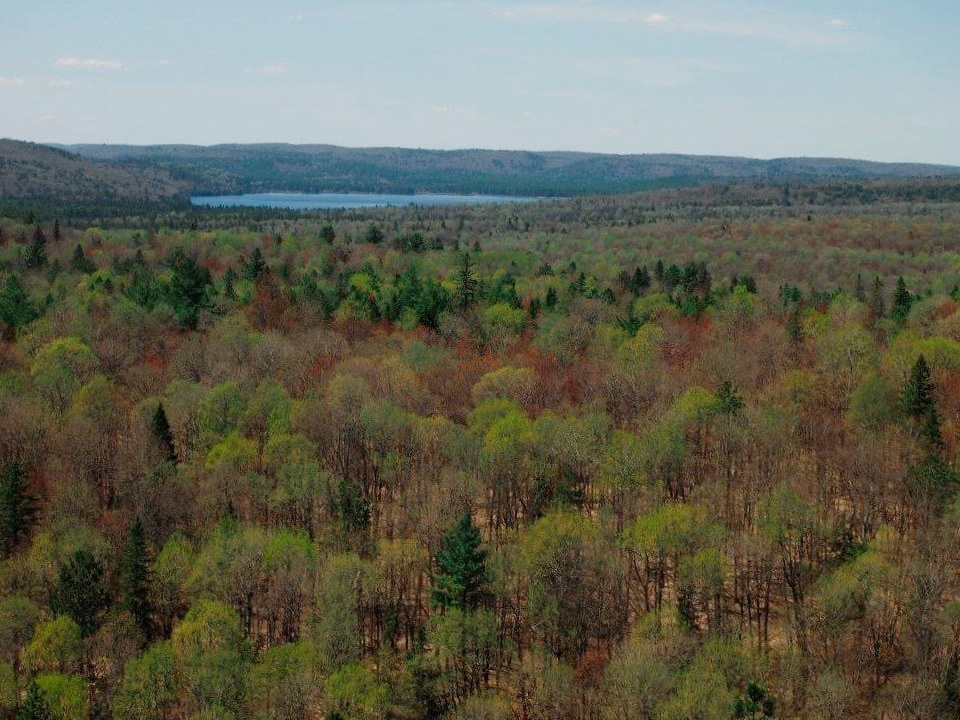
The forest in Spring was a sleepy sort of place. Even the dappled sun between the branches was like light filtering through drawn curtains. Birds chirped freely to remind the sleeping giants it was time for waking. The trees stirred from slumber and stretched towards the glow.
A rabbit scampered through the sparse underbrush, feeling a vague sense of relief for the coming growth. Food in abundance was a promise on the wind. The smell of damp earth was the smell of renewed hope.
This feeling spread through the soil as the trees shared their greetings, secrets, and nutrients. Soft conversations between roots; that interconnected system of infinite wisdom beneath the stand. The crowns were still bare, but a whole world existed below.
The wind was a sigh of relief as it passed gently in the weave of branches. A cloud, heavy with rain, drifted by and left puddles as it went. Small streams burbled and bubbled with rain and newly melted snow. A cheerful robin, just returned, hopped about the puddles and looked for worms amongst the mud.
As the trees woke and leaves unfurled, a joy returned to the hearts of all the beings there.
Happy Earth Day!
This is just a happy whimsical thing I whipped up to celebrate. This is also part of a project that brings together artists, writers, and other creatives for the Earth and celebrate 50 years of Earth Day. You can read more about it here.
Do you ever feel like everyone in the world knows more than you about everything?
Okay. Well, maybe not everyone. But many many people.
I often feel like I’m missing out on some great knowledge, though it only seems to be some vague idea of knowledge and not actually something tangible. Maybe I haven’t read enough books. Maybe I haven’t spent enough hours researching.
It could be my utter lack of being able to articulate my ideas into some sort of coherent sentence. Even in university, my ability to pontificate about the theme of my paper was fairly sparse. And my ability to pull random facts and anecdotes out of my brain is non-existent except for random moments where tidbits about Henry VIII’s wives are not needed.
Does this mean I’m not smart enough to write anything but these weird little rant-y blog posts?
Should I keep all opinions to myself lest I have to defend it with words I don’t have or ideas I can’t seem to bring forth?
Where are those pesky words, anyway? Where do they live in my brain? The inaccessible parts that can’t be reached for the darkness and cobwebs.
What books should I be reading or not reading or thinking about or daydreaming of being one day? Is there a limit to the knowledge one person can cram in one’s brain?
Sometimes I wonder about all the information I could fit into my head if it wasn’t filled with endless song lyrics and cat memes. Would I have more room for discourse on the emergence of the YA genre in the 1940s or how Catcher in the Rye and The Outsiders were the major catalysts of the genre becoming a popular one? Maybe not.
I guess Socrates would be proud of me for admitting my own utter lack of knowledge. The first step to learning is admitting one’s own ignorance.





 Jenna Goldsmith