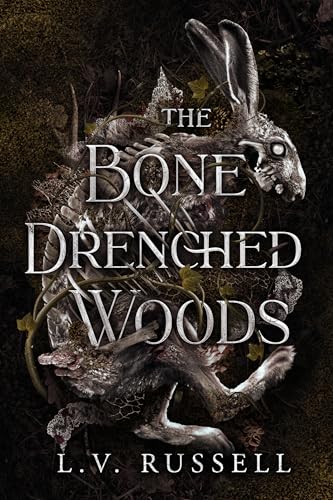
Book Review: The Bone Drenched

Though the fear never quite left them, with the darkness only a walk away and the echoes that haunted the night so close. Trees stood watch around the village edge like silent sentries, their darkness a solid thing, broken only by one thin winding path that led through the stoic boughs.

Carve the bones. One for the gate, one for the door, two for the mantel, and three for the floor… Hyacinth Turning knows the terrors beyond her village, the insatiable hunger of the Teeth. She listens to the sermons given by the Elders in their hare-skin masks. She watches as the heathens hang and the witches burn. They tell her to be good and quiet. But Hyacinth is neither good nor quiet. After a series of tragic events, Hyacinth finds herself hastily wedded and sent far away from all she has ever known to a settlement at the edge of the sea. Where more than just the Teeth are hungry. Another horror swims below, leviathan shadows kept at bay by offerings of flesh and bone.

But no sooner does Hyacinth take root in her new home do the Teeth and the Deep come to feed. Suspicion soon falls upon the outspoken Hyacinth, who spends more time with the outcasted Morgan Carroway than her own husband. The Elders want her burned, her husband wants her hanged, and a long-lost love claws at her dreams, but Hyacinth only wants one thing. A life and death of her choosing.

Amazon | Quill & Crow Publishing


I received a digital arc and I’m providing a review.

To begin with… The vibes. THE VIBES!

Every single moment of this book is dripping in deliciously unnerving folk horror vibes. One thing I can say for certain is that “The Bone Drenched Wood” (lovingly nicknamed “Where the Bones Boned” by me in a sleepy moment trying to describe the immaculate vibed to my husband) has a perfectly and skillfully crafted atmosphere that snakes like an eery fog throughout the entire novel.

Russell knows how to write a book. She knows how to carefully craft and distill horror in a way that shows her pure skill with language. She also knows how to tap into very real terror and delicately weave that throughout her novel to create a beautiful but absolutely unnerving tapestry of a story.

For me, I immediately thought of the M. Night Shyamalan film, “The Village,” especially the isolated village with spooky shenanigans going on, but with the folk horror turned up to 11.

Though, Bryce Dallas Howard’s Ivy Walker was more likeable than our FMC, Hyacinth Turning. Hyacinth walks the fine line between likeable and unlikeable, clever and foolish, feisty and down-right mean. To be fair, the world she lives in is incredibly harsh and horrific, but I had trouble deciding if I was rooting for Hyacinth in certain parts of the book. Personally, I would’ve loved to see a longer introduction of her character to get a better understanding of her free-spirited character.

We were thrown a little too quickly into the plot, which meant that I didn’t get to know Hyacinth’s character until she was in pure survival mode. I think a slower build opening would’ve also allowed for more establishment of the world the audience finds ourselves in.

This world is full of terror. I mean, them woods be bone DRENCHED. As I was reading, I felt like I was on a rollercoaster in the dark. I never knew what was going to happen or what terrors were lurking on the edges of the pages. It was a lot of fun, but I also craved to know more.

There were tiny tiny hints of the world beyond the Deep and the Teeth, but even within our isolated situation I felt like the lore of the land was mysterious… for better or worse.

The rituals throughout the book gave glimpses into the folklore surrounding them, but at the same time, I wanted to know more about the history. Questions I found myself coming back to were: Is this how it’s always been? Is this how it always will be? What lies beyond? Is there even a beyond?

None of my questions were answered.

And this was clearly a creative choice, continuing the conjuring of these amazing vibes by leaving the audience feeling just as claustrophobic and lost as the villagers themselves. That doesn’t mean it didn’t leave me feeling somewhat unsatisfied.

Russell also crafted a purely imaginative cast of characters to populate Hyacinth’s world with her. Everyone felt very real and solid as I was reading, even if I was somewhat horrified by their actions most of the time. Some of the villagers felt as if they could’ve been plucked right out of colonial New England at the height of the witch hunts. The question of who was actually trustworthy was always on my mind.

But, another thing that left me a little unsatisfied, was that the motivations of many of our main characters, even Hyacinth herself, were a little muddled in my opinion. Of course, everyone was just trying to survive, but there were moments when I found myself asking, “why is this happening?”

Another moment I found myself asking that question was at the end.

Abruptly we were thrown into the climax. It felt like there was this long period of trudging through existence in the village of horrors then suddenly everything was happening all at once. While it was a wild ride, I felt like it was a little rushed and I didn’t have time to process what had just happened when something else happened.

The very end seemed like it should’ve been a full circle moment. It made a certain amount of sense for the way the book began, but I felt like, as much as there were certain moments of foreshadowing, it felt like it wasn’t built up to enough.

Maybe it’s because the pacing needed some adjustment. Certain moments, especially those of great emotional tension, seemed a little rushed from my point of view. I felt like I never quite grasped what was going on.

Of course, this is clearly a creative choice made by Russell, trying to craft the story into the vibes, but to a certain extent a reader does need to feel like they know what’s going on while they’re reading.

This is not to say I didn’t enjoy the book. I enjoyed immensely! Russell is very talented and I’m excited to read more of her work.

If you like a fly-by-the-seat-of-your-pants folk horror, reminiscent of “The Village” but with better supernatural elements, you’ll really enjoy “The Bone Drenched Woods.”

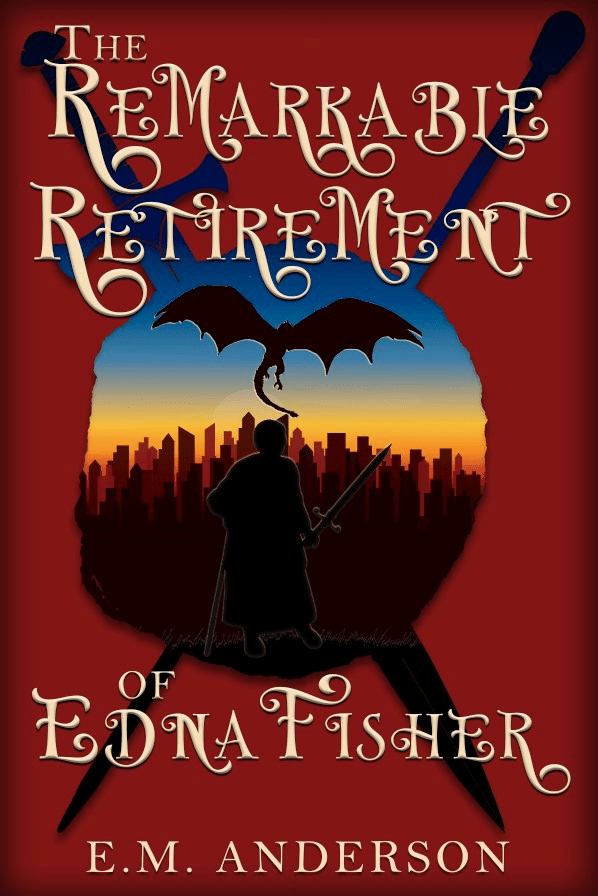
Book Review: The Remarkable Retirement of Edna Fischer

Kiernan hoisted Edna onto the dragon’s back with a grunt, but it took several minutes to convince Benjamin to touch the beast at all. At last Edna said, “Benjamin, I love you, but if you don’t get on this dragon this minute, we’re leaving you behind.”

When you’re a geriatric armed with nothing but gumption and knitting needles, stopping a sorcerer from wiping out an entire dragon-fighting organization is a tall order. No one understands why 83-year-old Edna Fisher is the Chosen One, destined to save the Knights from a dragon-riding sorcerer bent on their destruction. After all, Edna has never handled a magical weapon, faced down a dragon, or cast a spell. And everyone knows the Council of Wizards always chooses a teenager—like the vengeful girl ready to snatch Edna’s destiny from under her nose.

Still, Edna leaps at the chance to leave the nursing home. With her son long dead in the Knights’ service, she’s determined to save dragon-fighters like him and to ensure other mothers don’t suffer the same loss she did. But as Edna learns about the abuse in the ranks and the sorcerer’s history as a Knight, she questions if it’s really the sorcerer that needs stopping—or the Knights she’s trying to save.

Goodreads | Amazon | Bookshop.org


Where do I even begin with this book?

Maybe I’ll start by saying how happy I am that people I know personally on Twitter are publishing such amazing books!

My participation in the Twitter writing community is sketchy at best, but, even from the sidelines with the occasional cheer here and there, I still love watching talented writers get the recognition they deserve.

Anderson has managed to weave together a heart-wrenching yet touching story with world-building that was so vibrant and fresh, I was thrilled from beginning to end.

Edna, our leading lady, is highly relatable, as someone who could be described as an elderly person trapped in a 30 year-old body and I had so much fun rooting for her. Maybe I’ve read too many books with unlikable main characters recently, but I LOVED how likeable Edna was. I really wanted to see her succeed, even if I wasn’t sure how that was going to come about.

And I’m such a sucker for found family stories. The somewhat haphazardly thrown-together group of characters went straight to my heart. Okay, Clem took her time getting there, but even she made it in the end.

These characters inhabit such an interesting world. Before I sat down to write this review, I was trying to find the best words to describe it.

It’s almost Arthurian in scope, with dragons and knights and wizards, yet is much more expansive and diverse than that. These fantastical elements are layered on top of our very modern world, which leads to things like enchanted cellphones and flying cars.

Anderson clearly made an effort to make their world realistic while still bringing it with the magical elements. It’s very obvious as Edna moves through the world that this is a richly diverse place.

It’s a world I would like to live in, even with its flaws and dragon attacks.

Speaking of diversity, I couldn’t help but be tickled by the representation in the novel. As someone on the ace spectrum, I appreciated how Anderson addressed the topic of asexuality without being too dismissive or forceful about it. We got to see a couple variations of asexuality, which is amazing.

The writing was clear and easy to lose yourself in. I find sometimes with fantasy novels, the writing tries to be overly clever or it gets bogged down with too much detail or the dreaded “info dumping”, but Anderson did not fall victim to this at all.

And, maybe it was just me, but the twist… I did not see coming.

I gasped.

Anyway, not to give anything away, but the ending was so heartwarming and wonderful. If you like cozy fantasies that will simultaneously rip your heart out and also heal your soul, you will really enjoy this book.

Considering this is Anderson’s debut novel, I’m so excited to following along on their writing journey and read anything else they let me read!

Why Can’t I Just Do The Thing?

It’s a very normal rainy Monday. Emails have been answered, voicemails checked, and all my Monday duties completed.

So I find myself scrolling through Instagram.

A very normal activity, which usually yields some pleasant feelings as I’ve curated my feed to only contain things that make me happy or inspire me. Until I come across a post by someone I recently started following.

She’s fun and quirky and I think we’d be friends in another life. But this post hit a nerve.

It was a picture of her, taken by her young son, and nothing special or out of the ordinary. The caption, though, is what really got to me:

“Writing, working on a farm, music directing, and getting perpetually photographed by The Kiddo makes for a harried but happy few weeks.”

The audacity, am I right?

No, there’s nothing wrong with what she said or what she posted. Yet, it still managed to strike a chord with me… poke at a bruise I didn’t know I had.

Jealousy. I was jealous.

She lists off all these things that she’s doing and I know she’s also maintaining a fairly successful TikTok account (which I also follow) while knitting a 9-foot-long scarf.

My knitting project has sat unloved for months.

And that’s the crux of the problem. I see someone doing the things that I want to do⏤things that I myself am perfectly capable of doing⏤and instead of using this nudge as a reminder and inspiration to go do the things I want to be doing, I seeth with jealousy and feel bad about myself.

Self-pity is easier than just about anything.

As my moment of fiery jealousy subsided, it was replaced with frustration at myself. The question popped into my mind: Why can’t I just do the thing?

“The thing” being writing, knitting, getting into horticulture, painting, photography, or anything that I’m passionate about. I have a long list of things I’m interested in that could be the thing.

And yet, I don’t.

I’ve been sitting on edits for my novels for months⏤if a digital file could have cobwebs and mold, I’m sure it would; I used to do yoga almost every day and now I can hardly manage a couple days in a row; I take pictures that never end up being shared anywhere; after one farm rejected my volunteer application, I basically gave up on the idea I had of getting into horticulture; I’m trying to learn German on Duolingo.

I even have two of my friends’ books that I promised to read through and edit!

What do I do instead?

Honestly, I couldn’t tell you. Most of the time is probably spent scrolling on my phone and then suddenly the whole day has come and gone.

The more I spend my days like this, not doing the things I want to do, but mindlessly passing the time away, the more shame I feel. And with more shame, the less likely I am to return to the things I want to be doing.

Basically, it’s an endless cycle of suck.

I’m not sure why I let myself get into these cycles. Maybe absentmindedly watching days go by is easier than confronting the anxiety I have about the future and about the projects I’m passionate about.

I can’t go on!

A couple years ago I was so dedicated to mindfulness and staying present and I’ve lost that a bit. But, that doesn’t mean I can’t find it again.

Here are some things I could try in order to break this vicious cycle:

  1. Small Steps
    I have this philosophy that half-assing something is better than not doing it at all. 5 minutes of yoga is better than none. One written sentence, even if it’s terrible, is better than none. Any progress is progress. But I can’t seem to follow my own advice, even though doing one Duolingo lesson or looking at my edits for 10 minutes would make me feel so much better.
  2. Set a Schedule
    Everything, Everywhere, All At Once is the title of a very good movie but also how my brain expects me to operate on a daily basis. Instead of focusing on one main goal (like editing a chapter or finishing a painting), I expect myself to complete multiple things. Except everything takes a lot longer than I think it will, so I only end up getting one or two things done anyway. Then I feel like a failure. Instead, I will set out certain days for certain things, ie. Mondays are for blog posts and tidying, Tuesdays are for editing, Fridays are for reading, etc.
  3. Leave Space for Grace
    Not everything is going to go perfectly every time. Things happen, life gets in the way, and a day is suddenly over without anything getting done. It seems a little counterintuitive to say that when it was the one thing I was just complaining about, but not leaving room for rest or distractions, means that the guilt and shame cycle just begins again. Holding myself to impossible standards is not going to help… despite what my brain might tell me.
  4. Permission to Brag
    As a timid, quiet, neurotic introvert, my accomplishments, no matter how small, go uncelebrated and unacknowledged. I don’t take time to appreciate what I’m doing or give myself even an ounce of credit when I finish a task. I wrote a whole-ass book once and I brush it off like it’s no big deal. It is a big deal! Other people get to talk about stuff they’ve done, other people get to be proud of themselves, so why not me? Hyping myself up would help keep me motivated to keep moving forward.

The Thing™️ is not out of reach. I just need to get out of my own way. This list is something I’ll probably need to employ over and over again when I inevitably forget and go back into the shame spiral, but for now I am moving forward.

Go me!

Eliza: A Ghost Story of Christmas

Eliza never thought she’d have romance at Christmas. Nothing from her twenty-eight years had given her reason to believe otherwise. But still, when she watched those Hallmark Christmas movies, she couldn’t help but wonder if it would someday happen to her…

Snow drifted down outside the office window, making everything look more like a snow globe than a completely ordinary city street. It was mid-afternoon in late November and the sun was already starting to set somewhere beyond the thick blanket of clouds. 

The smell of peppermint and chocolate drifted from a steaming mug on the desk. Eliza sat in her desk chair, wrapped in a fuzzy knit shawl, stirring her hot chocolate unconsciously with a candy cane. It melted slowly, infusing the hot chocolate with a pleasant peppermint flavour. With her other hand she was scrolling through an article she was editing for the magazine. 

It was for the first issue of the new year and needed to be done soon, but Eliza found her eyes wandering to the window. The snow was so pretty, coming down in large fluffy flakes. She allowed herself a moment to imagine she was at a ski chalet in the mountains, surrounded by snow-covered pine trees and never-ending wilderness. 

Just her and peace and quiet. 

A honking car on the street below broke her from her reverie. She checked her watch quickly and flipped the lid of her laptop down. With a sigh and a stretch, she got up from her desk. Leaving her shawl on the back of the chair for tomorrow, she wrapped herself in a red plaid wool peacoat and a red wool scarf to match. She adjusted her scarf so it just about covered her chin—no frostbite for her, thank you very much. 

Outside, the winter wind nipped at her cheeks. In the air around her, the snowflakes twirled on the breeze like tiny ballet dancers. 

Standing just outside her office, Eliza imagined the life that might’ve been if she’d stayed in dance class as her mom had wanted. A life that would’ve involved rehearsal for the Nutcracker, no doubt. For nearly fifteen years, her life was dance shoes and tutus until the competition had become too much and Eliza had her first panic attack. It took another year of therapy to convince her mother she needed to quit dancing. 

In that time, she’d channelled her feelings into writing and found a passion there. Thus, her path changed, and she hung up her pointe shoes and attended a writing program. One undergrad in writing and a Master’s in editing later, she found herself working at this literary magazine. Of course, it wasn’t as simple as that. There was hard work and plenty of tears. But that wasn’t a very romantic time of her life, so Eliza liked to simply luxuriate in the present. 

The bustling city didn’t seem very festive on the surface—all hurrying commuters and people trying to get home for dinner, cars honking at each other, and dirty slushy snow piled next to the road. But, Eliza saw things differently. 

She saw the guy selling hotdogs in a Santa hat and the twinkly lights and Christmas trees in the shop windows. Somewhere in the distance, a busker was singing “Last Christmas.” Amongst the snow, it seemed like all was merry and bright. 

Was there any place better to relish in the joy of the present than a bookstore? In Eliza’s opinion, there wasn’t. Luckily, there was one just down the street. In a matter of minutes, she reached Parchment & Ink. 

The bookstore was a quilted blanket found in an antique wooden box in the attic, smelling of years past and untold stories. It was a patchwork of shelving with every genre imaginable stuffed into them. The books overflowed their shelves and piled on the floor in literary stalagmites. Two friendly and fluffy brown tabby cats either weaved their way in and out between customers’ legs or lounged amongst the books watching everyone with keen green eyes. Their names were Viola and Sebastian—after the Shakespeare play. Eliza once thought she’d figured out which cat was which but still found herself mixing up the two. 

It was the only place she felt truly at home outside of her apartment. 

Today, soft jazzy Christmas tunes played from a small speaker near the counter next to a cider-scented candle. Many customers at this time of day were those whose need for books exceeded their need for a meal or the comfort of their own home. Eliza’s kind of people. 

“Hey, Liz!” 

The middle-aged woman behind the counter waved at her enthusiastically before pulling her long black hair into a pony tale. The name tag on her shirt read Cecelia. 

If Eliza imagined “growing up,” she imagined she would be a woman like Cecelia. She didn’t fear age—wouldn’t let anyone in her presence fear it either— and let her streaks of silver hair grow without interference. Cecilia wore vintage band t-shirts and had taught herself how to play guitar after her husband had left her for his assistant. 

“The man is a walking cliché,” she’d explained to Eliza one day after the divorce papers had been signed. “But it’s finally given me the freedom to do things for myself.” 

The one good thing to come out of the divorce was that Cecilia got full control of the bookstore, and it became even more of a haven for writers, artists, and readers alike. 

“Hi, Cecilia, how are you?” Eliza said, dodging past a pre-teen sitting next to a pile of teen fantasy. 

“Oh, same old! Life is good! The books are good!”

Cecilia always seemed to speak in exclamation marks and her vivacious nature always drew people to her. 

“That’s good to hear,” Eliza said with a smile before disappearing into the stacks. “Will you be coming for dinner on Friday?”

“You know it, Lizzie girl!”

This woman was the closest thing Eliza had to a mother, as both of her parents had died in a tragic car accident the day before her twenty-fifth birthday. Cecilia had taken Eliza under her wing and comforted her in her grief. The bookstore had kept her afloat in the ocean of her pain. 

This time of year was always hard, but with Cecilia, the bookstore, and her friends, she got through okay. Even on a good day, she was never one to deprive herself of the company of a new friend. Even if it was only made of paper. 

She wound her way through the labyrinth of bookshelves and around book piles. Her favourite thing about the bookstore was its infinite nature. Logically, there had to be an end, but when she was in the middle of it there didn’t seem to be. 

There were a couple of people traversing the maze, but Eliza didn’t pay them much attention as she scanned the shelves for something in particular. As she grew closer, her fingers brushed against the book spines. Along and along, until… 

Another hand brushed against hers to get at the book she had been just about to grab herself. The hand, which now held the book she desperately wanted, belonged to a person—a man, specifically—wearing a maroon sweater and a charming smile. Waves of black hair fell about his forehead and over his right eye. His eyes were a deep blue-grey, like a November storm, but they sparkled with a certain mischief that softened the effect. He had just the right amount of effortlessly scruffy stubble.

“Sorry, were you after this one?” this stranger asked. 

“Yes, I was, actually.” 

Eliza stepped back and crossed her arms over her chest. She felt oddly possessive of the book, in her bookstore. What right did this roguish charming-looking fellow have to come here and take her books? He was dressed smartly in his sweater and dark grey slacks and looked like he belonged in a store like this, but she’d never seen him before. 

He looked down at the book and Eliza couldn’t help but notice his long black lashes. He smiled to himself as if he was very pleased that it was this particular book that was the cause of their altercation. 

“You have good taste,” he said, looking back at her. “But, I’ll have to offer my sincerest apologies. This seems to be the last copy.” 

“I should say you have good taste, considering the bookstore you chose to pillage.” 

“Pillage?” He said, his lips turning up into a smirk. “Is that what they’re calling lawful transactions of goods for money these days?” 

“It’s what I call taking the last copy.” Without stopping herself, she also blurted out, “In my bookstore.” 

His eyebrows raised. “Your bookstore? Are you the owner?” 

Eliza felt her cheeks turn scarlet as she managed to stammer her way through an explanation. “No, I—uh—just know the owner. She’s like a mother to me.” 

“Yes, of course, ownership by proxy. Though, does that count when you’re not blood-related?” 

“Maybe not,” Eliza admitted, feeling herself deflate. “I guess I’ll have to admit defeat. You did get to it first.”

“You put up an honourable fight,” he said, holding out his hand. “I’m Gerard.” 

“Eliza,” she responded, slipping her hand into his. It was warm and strong and somehow comforting. 

“Well, Eliza, maybe I’ll see you here again.” 

There was a hesitation when he let go of her hand, so slight that she thought she might’ve imagined it. She was flustered, grumpy, and didn’t know what to say so she let him go. But, as she walked away she wondered if maybe he had been flirting with her. 

It was prosperous, though. These types of things—meeting a guy in a bookstore—never amounted to anything, only reserved for books and movies, so it wasn’t worth another thought. She regretted losing the book, but there were always more to be had. Goodbye book and goodbye mysterious gentleman. Despite what he said, she doubted she would ever see him again. 

That is until she saw a small wrapped package on her desk the next morning. The paper was a delicate shade of red with a gold shimmering pattern without any tag. 

She looked around as if she could see who might’ve left it on her desk. Of course, not one but her coworkers were around. She made eye contact with one, an older lady by the name of Belinda with a sharp blonde bob and the sharpest eye for grammar Eliza had ever seen. Belinda gave her a knowing look but said nothing. 

There was no help for it, she’d have to unwrap it and hope for a clue inside. Though, that wasn’t necessary. Inside was the book. 

There was a hand-written note inside, as well, tucked in the first pages on a little scrap of paper. It read: The look on your face was too much to bear. Congratulations, you win. 

Eliza frowned and smiled then frowned again. The audacity of this man was something she’d never experienced before because no one in real life would behave like this. She stared down at the note with suspicion as her hands gently caressed her book—returned to her at last. 

Did he have any expectations of her? There was no phone number on the note, so maybe it was just some friendly gesture. Did this type of thing even happen anymore? Or at all? It seemed just as likely as meeting a man in a bookstore. 

This conundrum played around in her mind all day, leaving her distracted and unable to do much of anything besides write mindless drivel. 

When she got out at the end of the day, she couldn’t quite tell if she was surprised or not to see Gerard standing next to the resident coffee stand with two cups in his hands. When he saw her, a smile spread across his face. A dimple appeared in one cheek. It was much too much charm for one man and entirely unfair to be directed at her. 

“I guessed you might like a hot chocolate. I asked for the peppermint kind,” he said as she approached. 

He held it out to her, though she didn’t immediately take it. 

“It’s not poisoned,” he laughed as she took it. “I’m not that much of a sore loser.”

The warmth was nice in her hands and she watched as he took a drink from his cup. “So festive,” he said slowly. 

“What are you doing here?” 

The smile on his face fell just a little bit—clearly, he wasn’t used to women not immediately falling at his feet. 

“What do you—“

“I mean, what do you want from me?” 

He looked taken aback. “I’m sorry if I’ve done something to offend you. I was hoping for nothing more than your company if even only for a brief moment.” 

“You—I—Who talks like that?” Eliza blurted, feeling suddenly flustered. “You can’t be for real.” 

“I assure you, I most certainly am real,” he said, looking as if he was trying not to laugh. “Honestly, Eliza, I could tell you loved that bookstore more than anything and that look on your face when you realized you had lost out on a particular book…” He laughed for a moment. “It’s been a long time since I’ve found anyone as passionate about books as I am. If I was too forward or aggressive, I sincerely apologize.” 

Eliza felt herself relax a little. “I didn’t expect to find that book on my desk this morning.” 

“The owner–Cecilia was her name, wasn’t it?–noticed our conversation. When I told her I felt bad as I was paying, she casually mentioned where you worked. It seemed like a good idea at the time.”

“I guess you’ll know better now,” Eliza said, finally taking a sip of her hot chocolate. The soft and fresh peppermint tip-toed across her tongue and warmed her heart—just a little.” 

“Oh, I certainly do. Note to self: don’t stalk women you’d like to ask out.” 

They both laughed. Snow began softly falling around them. 

“You want to ask me out?” Eliza asked. She didn’t know whether it was the sparkle in his eyes or just the magic of the season, but she felt her suspicions melt away. She wanted him to ask her out. 

“Very much so.” 

“Would walking me home count?” 

“Definitely not,” he said, standing up straighter. “But, it will give us enough time to decide where we’d like to go.” 

So he walked her back to her apartment building. If Eliza hadn’t been enchanted by him when they first met, she certainly was by the time they made it to her building’s door. The conversation flowed naturally between them as they spoke about their shared love of literature and the city. Gerard laughed easily and Eliza felt as if she could tell him anything. He worked for his father’s company–some fancy finance thing Eliza had almost no interest in–but was waiting for the right moment to take off and make his own way. 

“I love my father and I’m grateful for the opportunities he’s given me, but I can’t stay in his shadow forever. The trouble is, I’m not sure what I’m passionate enough about.”

“Books?” Eliza suggested innocently. This seemed to be a weighty topic and Eliza didn’t want to step too deep where she wasn’t welcome.

“How does one make a living with books?” Gerard posited, shooting her a teasing smile. “I’m not a writer, like you, and I’m not business savvy. Books are a dying business, tragically.” 

Eliza wasn’t completely sure what to say, but Gerard graciously changed topics and they moved on to happier things. As Eliza watched him speak, she noticed a freckle on the left side of his neck just above where his grey woollen scarf was wrapped. She thought to herself–a completely innocent thought, of course–that she’d like to get to know that freckle more intimately.

Just as she was imagining all the ways she might go about it, they arrived at her door. It wasn’t a particularly interesting door, but it was hers nonetheless. 

“This is me,” Eliza said ruefully. If she was being perfectly honest, she enjoyed their time together more than she expected. Something deep inside stirred with something that could be considered, but what was the worst that could happen? 

He looked at her with a look that told her he was feeling vaguely similar. “Can I see you again?” 

Eliza hid her vast relief with a gentle nod. 

After they exchanged phone numbers, they went their separate ways; Eliza into her apartment and Gerard to wherever he had come from… though Eliza found herself very curious. 

She wouldn’t have to wait long, though. Soon enough they were seeing each other almost every day. Gerard planned a romantic date night, but as it was blizzarding they settled for a movie in his townhouse while he cooked dinner. 

He was a fantastic cook and had surprisingly good taste in furniture and movies. At least in Eliza’s humble opinion. 

The two of them were quickly and deeply enamoured with each other. How could they not as they walked hand-in-hand amongst the snow and Christmas lights? They had been doomed the moment they met in the bookstore. 

“Would you like to come with me to my family’s ski chalet for Christmas?” 

They were having a lunch date almost exactly a week before Christmas and Gerard was looking at her with his deep storm-coloured eyes as if there was a chance she’d say no. Honestly, it took Eliza by surprise. They’d been enjoying their time together, but Eliza didn’t imagine that he’d want her to spend Christmas with his family so soon. 

“You don’t need to look so terrified,” Gerard said with a chuckle. “I figured you might want to spend Christmas away from the city for once. Maybe enjoy the peace and quiet in the mountains.” 

She almost laughed, thinking about the daydream she had of a ski chalet on the day she’d met Gerard. Either way, it sounded like perfection. She could almost imagine the snow-capped mountains and the forest as far as the eye could see. Then she imagined Gerard’s parents. From what she heard, they were loving and supportive, but how would they react when their eldest son brought a girl he met less than a month ago to stay with them at Christmas? 

“Are you sure I wouldn’t impose?”

“Of course not!” He reached over the table and clasped her hands in his. “I want you there. At this point, I can’t imagine being there without you.”

“Nobody talks like that,” Eliza said teasingly, squeezing his hands. 

“I do when I’m with you,” Gerard said with a sly grin. 

And that is how Eliza found herself with an arm full of red and white roses as a thank-you gift, standing in front of what amounted to a small mansion perched on the edge of a mountain in the middle of a blizzard. Mere hours before, Eliza had been on the phone with Cecilia, reassuring her that she would be fine leaving the city for the holidays. 

“Are you sure?” Cecilia asked. “You don’t know these people at all.”

“It’ll be alright,” Eliza said, trying not to sound as if she was convincing herself as well. “Gerard has told me over and over they’re excited to have me.”

“If you say so,” Cecelia said, sounding dubious. “I will miss your shortbread cookies, though.”

The winds whipped her hair around her face, despite her knitted hat, and slashed across her face like icy knives. Snow swirled around her like a cyclone of white and flew off the tops of the swaying evergreen trees. She’d never seen so many in her entire life. 

It was intimidating and harsh and beautiful.

The chalet itself was a log cabin expanded to epic proportions. Eliza counted four chimneys, two sun-porches, and a partridge in a pear tree. It was grand and rustic and lavish and cozy. Someone had even hung red and white Christmas lights from all the eves, around all the large windows, and the double door at the front. Two huge wreaths of greenery and red berries were hanging from the doors. 

Even in the cold and snow, which should’ve made her miserable, Eliza could be nothing but impressed. 

“I guess it’s a little…” Gerard started. 

“Beautiful?”

“I was going to say ‘grandiose’.”

Eliza laughed as they joined hands and walked to the door. “That is true, but it’s also elegant and so charming.”

Gerard opened the door for them and led Eliza into a warmth she hadn’t felt in a long time. They walked right into a grand entrance, which looked more like a great room with towering ceilings of exposed wooden beams and golden chandeliers. A huge fir tree decorated with red and gold ornaments stood next to the grand staircase leading off upstairs. As Gerard shut the door, the sound of lashing winds died away and left only the distant ethereal notes of piano Christmas music. The harsh cold and wet smell of the winter night was replaced by the scent of something cooking with onions, rosemary, and sage.

The entire family was waiting in the great room entrance to greet them. They were a row of three–mother, father, and younger brother–wearing matching grey sweaters with ruby-coloured poinsettias on their chests and friendly smiles on their faces. Eliza couldn’t deny she saw the family resemblance; in fact, Gerard looked like a younger version of his father. 

“You made it,” Gerard’s mother said, splitting from the group to come to hug Eliza and her son. “Eliza, we are so happy to have you for Christmas.” 

“Thank you so much for welcoming me. These are for you.” Eliza said, handing the bouquet of red and white roses mixed with bunches of holly branches. In the snowstorm, the roses had been dusted with snow, outlining the red roses with frosty white.

“These are beautiful,” Gerard’s mother said smiling. 

She pulled back for a moment and looked at Eliza as if she were assessing the young woman. It made Eliza’s stomach turn uncomfortably, but it gave her a chance to take in the family. 

Gerard’s mother was a stately woman with her dark salt-and-pepper hair pulled back and piled on top of her head and pinned with glittering snowflakes. It was somehow regal and understated at the same time. She was only slightly taller than Eliza herself but seemed to carry herself with much more grace. Her slender nose was dotted with freckles, and her perfume reminded Eliza of the designer stores she’d only ever walked past in the city. 

His father looked so much like his son, except for a few key features. His hair was streaked with silver and he was clean-shaven, and he wore silver wire-framed glasses. A scar slashed through his right eyebrow, which gave him a somewhat sinister appearance, but his eyes were warm and lacked the mischief of his son’s. 

Gerard’s younger brother, Matthew, looked more like his mother. They had the same sharp sloping nose and striking blue eyes. He was more freckled, which gave him a boyish look. He didn’t look much younger, especially because he was taller than anyone else in the family. Where his family was all dark hair and stately frames, he was light blond and lanky. 

“My name is Marie, please make yourself at home,” Gerard’s mother said warmly before taking Eliza’s arm. “I’ll show you to your room.”

Eliza looked back over her shoulder at Gerard but he was already laughing and hugging his brother and father. She caught the eye of Matthew, who looked at her almost apologetically–as if he knew how it felt to be overwhelmed by a strange environment and a house of strangers. 

“Don’t worry, Lizzie–is it okay if I call you Lizzie?–I’ll have one of the men bring your bags.” 

Marie took her through the chalet. It was bigger than it looked from the outside and there were so many layers of rooms and hallways. Eliza was only able to catch quick glimpses of the rest of the place, but it screamed craftsmanship and detail. She wasn’t sure how, but it looked simultaneously modern but ancient–as if many generations had lived there before. Marie took her past the kitchen and dining room–a huge live-wood table sat in the middle of the room set with five plates–before moving onto a long narrow hallway. One wall was entirely windows, looking out into the stormy winter night, and the other was lined with closed doors. All except for the one at the end. 

On the open door there hung a simple wreath made of red alder berries. Through the door, Eliza could see a large fluffy bed with a red knit blanket and one pillow in the middle. 

It made sense that Eliza would be in her own room, considering she and Gerard hadn’t been seeing each other that long. In the typical fashion of these places, the bedroom was decorated with white walls and light grey furniture. The room itself looked bigger than her entire apartment and the bed especially looked tantalizing. The frame was made out of what looked to be mahogany and, if it wasn’t antique, it was made to look like something out of the 1800s. 

Marie stood at the door and watched Eliza admire the room with her hands clasped in front of her. 

“Do you like the room?”

“Oh yes,” Eliza said, “it’s beautiful. The whole place is beautiful.” 

Gerard’s mother looked pleased. “Wonderful. I do hope you enjoy your stay with us. It’s been too long sing Gerard has brought someone so lovely home for the holidays.”

“Has he brought many?”

Marie waved her hand dismissively. “Please don’t misunderstand me. I only meant you are a refreshing presence and we look forward to including you in tomorrow’s Christmas Eve festivities.”

“Oh yeah,” Eliza said, nodding her head. “Gerard told me you all do so many fun things on Christmas Eve, but he was a little vague on what the activities actually are.”

Marie clapped her hands and grinned. “You will just have to be surprised.” With that, she grabbed the door and began to close it. “I’ll have Gerard bring your bags and dinner will be ready in half an hour. Please make yourself at home.”

Dinner was roast chicken with rosemary, mashed potatoes smothered in butter, and root vegetables. It was simple, as Marie quickly admitted, but it was delicious. 

While Gerard looked most like his dad, his talkative nature he inherited from his mother. They spent most of the meal chatting, asking Eliza questions, and making jokes. Gerard’s father made his opinion known when he needed to, but Matthew looked almost sullen most of the time. Eliza couldn’t pinpoint why, as his mother and brother tried to include him in the conversation. It seemed strange, but perhaps that was just how he behaved around strangers. 

After dinner, Eliza and Gerard cleaned up and washed the dishes. As the evening went on, she felt the tension and pressure of being in a new place and around new people–whom she was trying desperately to impress–ease. 

“Did I do okay?” Eliza asked, drying the last of the glasses.

“Of course. You were fantastic. I’m sorry my mother is so talkative.”

“No, she’s lovely,” Eliza said, feeling her stomach flutter when she saw the smile on Gerard’s face.

She went to bed that night feeling cautiously optimistic about how the next few days would go. Maybe this was something. Eliza closed the door and the quiet set in. There was a sort of comfort to the quiet after such a hectic day of driving and the whirlwind of meeting Gerard’s family. 

But, it was sort of eerie as well. She could hear the wind still whipping by outside the curtained windows. Occasionally, some draft above the ceiling of her room moaned and sounded like the cry of someone in pain. The place certainly didn’t have the feel of somewhere one would see a ghost. At least, that’s what Eliza thought until she saw one. 

Eliza didn’t remember getting into bed and going to sleep, but she must have or she wouldn’t have awoken in bed to a dark room. There was no bedside clock to tell her the time and she didn’t remember where she’d left her phone. But, it was dark. The storm had quieted at some point, but that just left an obtrusive silence in its wake. 

The chalet made no sounds and, despite knowing it was inhabited by four other people, she felt horrifically alone. She didn’t even know where Gerard’s room was. 

Out of the darkness and silence came the softest noise. The hint of a whimper. 

Eliza held her breath for a moment to listen and the unmistakable sound of someone crying could be heard. She wasn’t sure why she didn’t just pull the covers over her head and try to go back to sleep. Instead, she carefully tiptoed out of bed. She felt around in the dark for some form of light and found the bedside lamp. She fumbled in the dark, trying to turn on the lamp but the switch didn’t work.

Though, she did find a metal candle holder with a candle on her bedside table as well. Next to it was a box of matches. After fumbling around, she managed to light one and held it to the candle. With the warm flickering light of the candle, she padded her way to the door. 

She opened it slowly, turning the handle all the way before pulling it open, so it wouldn’t make a sound. The night outside the windows gave no light to the hallway beyond, but Eliza heard the crying more clearly now. 

It was close. Behind one of the other doors. 

Eliza crept along the hallway, trying to be as quiet as possible. She paused at each door for a moment, listening for the sound. 

She tried one of the doors, thinking that may be it. Locked. But the one next door opened. 

Inside was just as dark as the rest of the house but as she stepped forward into the room, her candle illuminated a single figure. 

The room itself was bare except for a layer of dust that had accumulated on the floor. A certain smell of mould and decay lingered in the air. The crying figure was huddled on the floor with its arms wrapped around its legs, in a sitting fetal position. It wore something long and black, which covered most of its body. Spreading out from beneath them, along the floorboards, was this smear of dark red. There was no other sound, except their soft sobs. 

The sobbing stopped. The figure turned its head, revealing the skeletal face of a woman, with the blackened remains of her skin clinging tightly to the bone. Blood-red tears streamed down her sunken cheeks, but there were no eyes in the black holes of her skull. Her stringy dark hair hung about her like a funeral veil.

This woman reached a boney hand towards her, pointing a single finger, and opened her jaw wide. 

“Beware.”

The word seemed to come from a place not quite in the room but from the room itself. The sound–dry and cracked like stone dragged across concrete–swallowed her whole and caused her to stumble back into the hall. She dropped the candleholder, which clattered on the ground. Melted wax splattered in a shape, not unlike the bloodstain on the floor. 

The figure began to crawl towards her. Dragging itself along the floor with one hand and reaching out to her with another. Her mouth was agape and her tears dripped onto the floor, leaving little red stains as she went.

“Run.”

Eliza sprinted back to her room, the candle left forgotten on the floor and shut the door behind her. She struggled with the lock but managed to turn it into place. 

Silence had returned. There was no sound of the figure’s boney body dragging itself along the floor. No more words were spoken from some unholy place. But, Eliza was not comforted. 

She stood there in the dark, shaking and trying to breathe again. Her heart continued pounding long after she lay back down, so she stared at the ceiling–despite seeing the gaunt terrible face of the skeletal woman looking back at her. Even behind her eyelids, she saw it. 

She must have fallen asleep again at some point because she opened her eyes again and the yellow-white light of a crisp and clear December morning was streaming in. The outside peered through the gap in the curtains, showing itself to be a snowy wonderland. 

Eliza got up and went to the window and saw what the storm had left behind; glittering snow which covered the trees in heavy duvets of white powder. It looked truly magical. The surface of the snow was so smooth and perfect. In the trees, birds flitted back and forth and beyond lay the sprawling mountainside. 

All of the fright from last night melted away. It must’ve been a dream. The thought gave her some relief, though the dark clouds on the horizon indicated another storm was coming. 

The smell of breakfast lured Eliza from her room, still shy as a guest in a strange home, but she was greeted by four warm smiles. 

“Happy Christmas Eve! How did you sleep, Lizzie?” Marie asked from behind the counter of the kitchen island, where she was monitoring the progress of toast in a toaster. Gerard’s father was cooking eggs and bacon on the stove. 

“I slept well, thank you.”

Matthew turned slightly to look at her from his spot on a bar stool, which was pulled up to the kitchen island. He didn’t say anything but just stared. Eliza tried not to look at him, but she could feel the weight of his gaze on her. 

Gerard came and planted the gentlest kiss on her forehead. “You doing okay?”

Eliza simply smiled up at him and nodded. 

No one mentioned the candle, which hadn’t been on the floor when Eliza walked by. The hallway looked as if nothing had happened last night. Another reason why it must have been a dream. It had to be. 

“Would you like some eggs?”

“Yes, please.”

The day continued in a similar matter, but with all the expected cheer and festive merriment of the holiday. Despite the large and beautifully adorned tree near the front door, the men brought in a smaller fresh tree to be placed by the grand fireplace and decorated.  

“This is where the gifts will be tomorrow morning,” Gerard explained cheerfully as he handed her a glittering silver bauble for the tree. 

Marie drifted back and forth from the tree decorating to the kitchen again to make cookies. Making it all look effortless and keeping the mood cheery. Laughter always filled the room when she was there. 

Despite Eliza’s best efforts, she couldn’t get more than a few words out of Matthew. And, while he seemed cordial enough, Gerard’s father seemed distant too. Eliza figured this was simply because she was somewhat of an interloper in their family traditions. 

She tried to stay happy and accepted the hot chocolates filled with marshmallows shaped like Santa, especially when she saw how happy it made Gerard, but she couldn’t help feeling much like an outsider. Even before she’d lost her parents, they never celebrated quite like this; with the music and the decorations and the constant supply of Christmas cookies. 

After the tree, it was time to make and decorate gingerbread houses. Gerard and Eliza decorated their own smaller cottage, while the three other family members decorated the larger gingerbread mansion. In the typical manner of brothers, it ended up being a bit of a competition. 

As the day grew older, the clouds darkened the world around the chalet. The night seemed to be coming much faster than seemed normal even for a late December day. Stepping away from the warmth and laughter of the family was like being in a different house altogether. 

When Eliza excused herself from the after-lunch game of Christmas charades to use the washroom, the rest of the house felt dim and empty in comparison. It didn’t help that the bathroom was in the windowless interior of the chalet and Eliza couldn’t find the light switch. But, she’d almost made it when she heard a sound which made her blood freeze in her veins: the sound of bone scraping across the floor. 

Eliza couldn’t move, though the sound seemed to be coming from behind her. Her body seemed to move by itself, turning until she was facing the source of the awful scraping sound. 

This time the figure was standing, dragging her bony feet beneath the tattered black robe. Her posture was slouched and crooked like her spine wasn’t quite enough to hold up the rest of her body. The smell of death hit Eliza in a way it hadn’t the night before. She felt stomach bile rise in her throat, but she couldn’t do anything but stare. 

A skeletal hand was reaching towards her once again and her jaw was slack and open, from which a horrible sound was being emitted. 

Before the ghastly figure could reach Eliza, she turned and her wasted hand now pointed at a plain closet door. She shuffled her gaunt body towards the door and, with a final mournful groan, passed through it. 

It wasn’t a dream, after all.

Hesitantly, Eliza opened the door. Behind was only a closet, with nothing but some brooms a mop and cleaning supplies. No ghost. 

But, there had to be something in the closet the ghost wanted her to see. 

The closet was just big enough for one person and she as she took a step in, the floorboard beneath her foot squeaked and shifted. She lifted her foot and the board slipped back into place. It might’ve just been a loose floorboard–simply a coincidence–or it was a clue. 

She knelt and jiggled the board until it lifted. The black chasm beneath frightened her more than she would’ve thought possible. How could this exist under the chalet? Why might’ve been a more appropriate question. 

A gaunt hand reached out of the darkness, sending Eliza falling backwards. It grasped at the air before falling forward, and the fingers dragged along the floor before it disappeared back into the hole. Cautiously, Eliza crept forward and peered down into the hole. It didn’t take much looking to find what the spectre has wanted her to see. 

Even in the darkness, she could see the bones piled as if it was nothing but rubbish.  

Again, Eliza stumbled back, hands grasping at whatever they could find to stabilize her. There was nothing but a smooth hardwood floor. At once she was simultaneously breathing too hard and not at all. Her heart pounded out of her chest as she tried to stand, though her legs trembled. She had to get out. 

She pulled herself up off the floor, thinking only one thing: run. Her mind swirled and tilted like a carnival ride, leaving her unable to navigate through the maze of halls. One hand she kept firmly planted on the wall as if the touch of something solid would stabilize her long enough to find the way out. 

“Eliza? What’s wrong?” 

It was Gerard’s voice. It should’ve been a beacon of light in the dark, but what if… 

She’d stumbled her way back into the room where the family had been playing Christmas charades. They all stared at her now, their faces white and knowing. 

She couldn’t speak as she continued her mad rush to escape. 

Somehow she navigated herself to the front door and wrenched it open. The freezing air caught her and pulled her forward. The storm had come again, closing the space around the chalet to nothing but a violent snow globe. It was an escape, but only from those inside. She was trapped by the treacherous mountainside and the vortex of snow. 

She could hardly feel the cold as she trudged forward toward the forest that surrounded the chalet. The snow was almost up to her knees, but nothing but a literal wall of ice would have stopped her. When she hit the line of trees, she felt a moment of comfort, but it passed as quickly as it had come.

Voices called out from the open door. Spots of forest were suddenly illuminated by flashlights. They were trying to find her. But, Eliza would not be found if she could help it. On shaking legs, she moved deeper into the forest. Her eyes searched for somewhere to hide, but it was almost impossible to see through the snow and the approaching darkness. She had to do something. 

Farther and farther she went, though she couldn’t be sure how far she was going. She broke through the trees into something of a meadow. The wind calmed for a moment, making it easier to see. 

Eliza braced herself on the trunk of a tree to keep from completely collapsing, as she brought air into her lungs as fast as she could. 

The voices seemed a little closer and light bounced around amongst the trees. For a moment, the light hit something that wasn’t a tree. In the near darkness and snow, it was hard to make out, but it was indeed the shape of a person standing at the edge of the trees. A light passed over the shape again, enough to confirm the squared shoulders and towering form. In their hands, a knife glinted.

Despite the spots in her vision, Eliza scrambled backwards, merely falling into the snow. 

The shouts grew quiet and she could hear the distinct sound of crunching snow as the shadow stalked toward her. A single scream echoed through the trees, but was quickly swallowed by the wind and went unheard by any living soul. 

Meditating My Way Out of Comparison

People compare themselves to each other. I don’t know if it’s an evolutionary thing or something we’ve conditioned ourselves to do over the course of thousands of years. But, it’s something we do.

It’s not inherently a bad thing, as it helps us learn where we need to improve ourselves. If we see Bob building a better fire than us to cook his meal, then it makes sense we’d want to try to be more like Bob. It enables growth and an understanding of where we’ve come from and where we’d like to go.

But it’s a double-edged sword, and it’s easy to fall into the loop of discouraging yourself: “I’ll never be as good at that,” “I’ll never be able to do that,” etc., etc. If you can break yourself out of the cycle of discouragement and see it as another avenue of determination (ie, “How do I get to their level?”) then you can turn the sword on its head.

This negative loop is powerful though, and it’s been used against us in many ways.

For example, women face this every day as this comparison cycle is used as a way to market products of all shapes and sizes–without them, obviously, we will never be as attractive or successful or anything.

This negative loop, though, gets me every time and I have yet to find a way to break out of it while it’s happening. And, honestly, I’m tired of it.

Recently, I went through a short but intense period of imposter syndrome. My fellow writers will know the term as it’s a widely talked about phenomenon.

If you don’t know, it’s the feeling of being an imposter and not believing that you are qualified or have the skills to be where you are. You spend your time waiting for someone to call you out as the phony you feel you are.

The feeling can apply to anything.

But, I was feeling particularly bad about my writing career and the fact that I seemed to be surrounded by amazingly talented people, all of whom seemed to have books coming out this year or next. Instead of feeling inspired and happy that I was amongst great talent, I got into the comparison cycle of doom.

There was nothing I could do. Literally. I couldn’t write about it, I couldn’t work on my own book, I was paralyzed by these feelings of inadequacy.

That’s when I realized I had to do something to mitigate these feelings as they come up.

Well, maybe not the feelings, but the endless cycle of negative feedback that runs through my head as it’s happening.

I get so caught up in the negative thoughts fueled by anxiety, which in turn fuels the feelings of doubt and failure and turns it into a self-sustaining cycle, that I can’t seem to escape the loop.

This is where mindfulness and meditation comes in.

Meditation is a useful tool for learning and recognizing your thought patterns. Despite popular belief, it’s not really meant to quiet your mind or make your mind go blank. Instead, you are meant to be an observer of your thoughts and–with a focus on your breath–you let them drift away like clouds.

Through meditation, you can learn to be mindful of your thoughts and catch them as they arise.

Instead of falling victim to the thoughts that tell me I’m not good enough, or I’m never going to be a writer, or that everyone is so much more talented and amazing than I am, I can take back control and recognize that these are merely thoughts. I don’t need to internalize them, I don’t need to acknowledge them. I can engage and refute them or, better yet, I can just let them go.

But, unfortunately, I’m not there yet.

I’ve tried meditation in the past, many many times, and I can’t seem to stick to a good routine. It’s not for lack of trying or desire, but something just hasn’t stuck. I try these mediation challenges and I can keep it up for a time, but it always seems to slip.

I think this most recent hurricane of imposter syndrome and anxiety, though, is enough to make me want to build a solid routine.

So that’s what I plan to do for myself: A proper meditation schedule that will help me be more mindful of the negative thoughts as they crop up.

Hopefully, I’ll be able to come back here in a few months and write about what I’ve learned during this process.

Let’s Kill “Cringe”

I’ve always been kind of “nerdy,” whether it was video games, anime/manga, conventions, fantasy books of all kinds, fanfiction (ask me about my hand-drawn self-insert manga fanfic I started writing as a teen), fantasy role-playing in online forums, sci-fi shows and movies like Firefly and Star Wars, or even 1970s animated Lord of the Rings movies. I was into it all.

I still am, though my nerdiness has branched out into history, historical fashion, folklore, and storytelling. I don’t watch as much anime as I used to and I’ve realized I enjoy slower-paced video games and playing video games online in crazy fighting scenarios stresses me out. But, I digress. Basically, I’m passionate about what would be considered nerdy things.

Luckily, I never really felt like I had to hide that side of my personality.

My friends growing up were all kind of into the same things, so we never pressured each other to hide our nerdy natures. And in high school, my brand of “not like other girls” was the gamer/emo/nerd girl.

From my perspective, what was “cringe” wasn’t necessarily the same as the general “not nerdy” population. But, I definitely thought that being into Jersey Shore and pop music and Hollister was “cringe.”

That is until I grew up and realized everyone has their stuff. And I found I didn’t need to secretly act superior about what I liked or didn’t like. We are all passionate about different things and being “cringe” is a big lie.

And that’s why it needs to die. (oh wow that rhymed, beautiful)

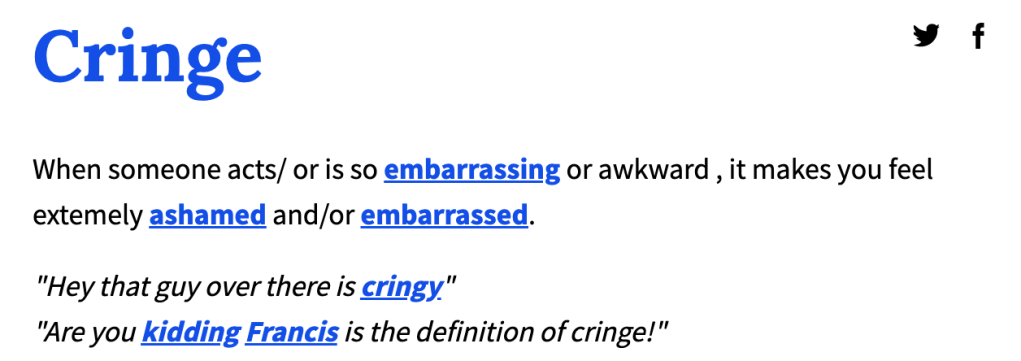
According to Urban Dictionary, the definition of cringe is:

Cringe: 
When someone acts/ or is so embarrassing or awkward , it makes you feel extemely ashamed and/or embarrassed.

This term is often used to describe people who are unabashedly into anything, nerdy or not. If you like something without inhibitions, you are “cringe.” But, I’m here to say that cringe culture needs to be put to death.

Let me ask one thing:

Why do you care so much about what someone else is interested in?

Imagine how much time and energy we could save if we just focused on our own lives. When we hide behind screens and act as if the joy of others affects us in any way, we waste so much of our lives. Imagine how much happier we could be.

Basically, cringe culture is just high school-style bullying for adults.

Aren’t we tired of trying to fit in? Aren’t we tired of all having to be the same? Aren’t we tired of having to pretend we don’t actually care?

Let’s just accept that everyone is a weirdo and we should let our freak flags wave as high as we want them.

Cringe culture is also kind of ableist because neurodivergent people often get ostracized from social groups for expressing their excitement and passions in ways that don’t necessarily conform to neurotypical ideals.

Even in my experience, as someone who is neurotypical, I found I could be myself in online spaces more than I could be in social settings in my real life. So, that’s where I went. But now, even those spaces seem invaded by people who want to police how we express ourselves.

Cringe culture even dictates how authors can or can’t market their books.

How ridiculous is that?

Honestly, joy and passion are so much better than apathy and sameness!

Not much spreads and expands faster than joy. When we share our joy with others, it brings joy to them and encourages them in turn to share their joy. Unless your joy is something murder-y or problematic, there is nothing wrong with sharing your joy.

We need more joy in this world. So let’s do away with cringe culture and embrace our personal brands of nerdiness!

I’m going to go paint some D&D miniatures… you do you.

Silent Night

Winter remembered death well. How it took to her like a charming suitor, resplendent in his black suit and tie—haunting eyes and all. The memory held shape in the dunes that formed of snow, in the bite of frost on cheeks, in the mournful paw prints wandering through barren forests. Death came in winter. So did the dead. 

But no one at the party was thinking about death or the dead. Why would they? They were all very much alive and well—for the most part. 

No one in the shining hall, with the sparkling fur tree, the smell of frosted cakes and lush fruit pies and rich wine, and the floating music from a string quartette, could imagine anything but being joyful and drunk on their fortune and wellbeing. Fore isn’t that what this time of year is all about? 

There was dancing. So much dancing. It was almost surprising, given the amount of food and drink being consumed by the guests. It truly was a wonder how anyone could move—or stay upright—but move they did. 

Oh, how they twinkled and sparked in their Christmasy best; like pieces of wrapping paper blown by the wind. How could any of them think go anything except the wonder of the lights and merriment around them? 

Outside the towering windows of the grand hall, snow was falling like cotton balls. The air was still and quiet, in the way it only can be when it’s snowing. The world seemed to glow under the brief light of the moon as it managed to peek through a sliver in the clouds. A silent raven flew across the inky sky as the clouds covered the shining crescent and snuffed out the glow. The raven let out one mournful croak before moving on.

It was indeed the darkest night of the year and the raven was not the most ominous creature about. 

But, who would know when the intoxicating aroma of balsam and cinnamon and citrus swirled in the air and filled the hall like decorations. Like glittering tinsel, they clung to every surface. 

Amongst the wonderful smells, the dancers kept dancing as if it was the one night of the year for it and the revelers kept reveling. All perfectly unaware of anything besides the fantastical party. As long as there was music, food, and lots of drink there was nothing at all to worry them. 

In a quiet corner, where no one had been for at least ten minutes and which would remain empty for at least ten minutes more, a securely fastened branch of greenery fluttered in a nonexistent breeze. In fact, it looked just about ready to come off its hooks, but a blink later it was still again. Not one person noticed the unnatural movement. 

If someone had observed the movement, they might’ve also perceived the shadowy figure drifting along the fringes of the merrymaking. Though, as soon as anyone could have beheld the figure, it was gone. Flickering in and out of existence like a firefly in the darkness. But the golden shimmering of scarlet and silver blinded the party-goers to just about everything but their own cheer. 

Now, old houses such as this one are apt to be full of hauntings and paranormal happenings, but this one seemed fouler than most. 

What made it fouler, I cannot tell. Maybe it was the fleeting sense of dread that suddenly filled the hearts of the dancers. Maybe it was black wax from an unknown candle dripped on brand new linens. Maybe it was the melancholic howl of some faraway hound—marking the commencement of a wild hunt; spirits abound and beasts chasing. 

The hunters gathered amongst the winter dunes, prepared for their prey which lay in wait unwittingly. Their laughter and boasting were lost on the wind, only to be heard by those quiet enough to hear. Fortunately, no one was near enough or quiet enough. 

The wind now began to howl with the dogs, beating unheard against the window of that old house—an unheeded warning. A desperate wail like the cry of a banshee. 

But the party went on. 

Above the house, a barn owl—white as the snow—took flight like a ghost, crying one last time before the last sparkling lights in the night were swallowed by darkness. Its unseen wings beat on, away from it all. 

In the great hall, with the twinkling candles and overflowing array of sweets and treats, the clock struck one but the dancers kept dancing. Around them, the candles began to flicker out one by one, as if blown out by an unseen breath. The light in the hall dimmed, but laughter and merriment echoed throughout until the last light flickered and was extinguished. 

The dancing stopped. The music stopped. The laughter stopped. Along with the chatting and snacking and singing. It all stopped. 

Like it had never been there at all. 

A handful of churchgoers, having just finished a midnight mass to celebrate the day, bracing themselves against the mid-winter wind with scarves and wool, tromped through the snow past the old house with its darkened windows. Their playful joking quieted as they went by, not wanting to disturb or even look at the house—sleeping as it always did, somewhat restlessly. 

“I don’t like going past that place even in the daylight,” one whispered to the other. 

“When we were coming out, I swear I could hear music in the distance.”

They both shivered and hurried on. 

And above the clouds broke, letting the moon shine once again through to the silvery world below. The house stood, keeping solemn watch, empty and alone. Whatever had walked there had passed on into the silent night. 

So much for summer love: Flash Fiction

“Are you sure?” he whispered against the skin of my neck. 

I’d never been more sure of anything. Even if this was my first time. 

“Have you ever—?” 

He shook his head. “Never.”


Our love story occurred in memories; in moments that slipped through my fingers like the sand. 

…It was the swirling air; 

…the salty kisses waist deep in the ocean; 

…glasses of wine snuck from my parents’ basement;

…his fingers tangled in my hair;

…my hands brushing the skin of his sun-kissed back. 

That skin, smooth and tanned, I wish I could leave some sort of mark—to prove I’d been here. I’d loved him. Sometimes I pretended I could. While he read a book in the sand, my fingers would trace my name over his shoulder blades. 

The imaginary lines existed only in my mind. His skin, much like his life, remained untouched by me. 


Meet me behind the mall.


September arrived in name only, as if August might’ve stayed if it held on long enough—if we had held on. If I had held on. 

But I was living in hope. For the hope. 

I kept my phone on late at night, next to the pile of homework that always formed when we went back to school. 

The silence was deafening. His silence, or mine, I couldn’t tell. There were so many times I wanted to pick up the phone and call. But, maybe the wanting was enough. Perhaps this summer was enough. 


This story was inspired by Taylor Swift’s song August! Thanks for reading!

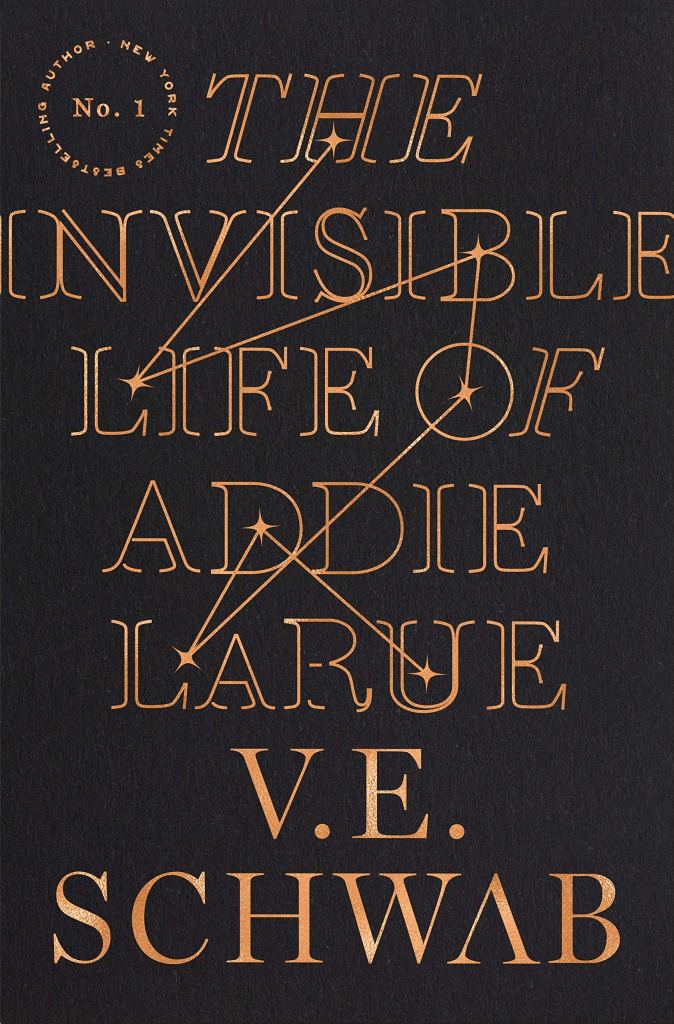
Book Review: The Invisible Life of Addie LaRue

“Three words, large enough to tip the world. I remember you.”

France, 1714: in a moment of desperation, a young woman makes a Faustian bargain to live forever and is cursed to be forgotten by everyone she meets.

Thus begins the extraordinary life of Addie LaRue, and a dazzling adventure that will play out across centuries and continents, across history and art, as a young woman learns how far she will go to leave her mark on the world.

But everything changes when, after nearly 300 years, Addie stumbles across a young man in a hidden bookstore and he remembers her name.

Goodreads | Amazon | Indigo

I wanted to like this book so badly and I quite enjoyed the first half. But, unfortunately I can’t join the hype train; as much as I wanted to be one of the ones to be yelling about how amazing this book is. And that’s the worst part. I was so excited about this book.

The premise was solid and Addie was an interesting enough character. The writing was beautiful and lyrical, though considerably repetitive, and I was interested to see what Addie would make of her life when she couldn’t be remembered. But, as I got farther in, the story faltered for me.

Around the half-way mark, little things started to turn me off from the story and from the characters. Two things happened which majorly quenched my enthusiasm for the book:

1) Addie LaRue has anti-feminine sentiments for no reason.

Page 157 from the book with a highlighted line that reads: "even cinched herself into a corset despite her loathing of bone stays."

For most of the book, she’s been this free-spirited, old God worshipping lady, who wants to subvert societal expectations because she wants to fully experience life. And she also hates corsets…

As someone who went through a “I’m not like other girls” phase and rejected all things feminine for a large chunk of my adolescence and who’s now worked through her internal misogyny to reclaim her more “girly” side with pride and power, it’s disheartening to see time and time again this rejection of anything feminine by female characters. On top of that, it’s not historically accurate.

Corsets were not these torture devises meant to keep women from breathing properly or damage their internal organs. No. They provided breast support while also supporting the spine and providing the wearer with the most fashionable silhouette without much effort. Now women go on diets to try and fit the most fashionable size.

But I digress… that’s another tangent for another day.

Addie’s personality flattened as the book continued on. It seemed her only personality traits were being alluring and pretty. And don’t forget the freckles.

I guess when you live for three-hundred years with the shallowest human contact, you don’t really need to have a personality. Or maybe everything about Addie’s personality was brushed over so she could be swept away by Luc every scene she wasn’t with Henry. But, it became increasingly tedious to read.

2) Henry is so boring

Henry, our love interest, is part of the great premise of the book. He remembers Addie. When he was first introduced I was so excited. But, then we got his backstory and a whole section of just him and I completely lost interest.

At first, he’s introduced as this sensitive character, and as a highly sensitive person myself I was all for it. But, I quickly came to realize that he doesn’t actually have a personality either. Depression and anxiety clearly play a role, but it’s hard to read a character who doesn’t want anything or doesn’t seem to do anything but sulk. His self-pitying lack of personality made him an almost non-character. I didn’t see the point of him besides being a foil to Addie.

Reading his chapters was a struggle because there was nothing in his character that made me want to root for him. He lives a life where nothing quite works out for him and people are disappointed him and his girlfriend of two years doesn’t want to marry him. But, all he did was obsess that he wasn’t good enough. His personality doesn’t seem to exist outside of when he meets Addie and they fall in love (instantly if I might add).


Other than those two things, the second half of the book began to drag. As I mentioned before, the writing is so repetitive at times that I wanted to pull my hair out. If I read that Addie has seven freckles spread across her cheeks or about Henry’s black curls one more time… The pretty writing couldn’t save itself from itself.

As we continue to watch Addie’s life in the past and present, we don’t see Addie doing anything. She’s been granted the ability to see the world and all we see is Addie doing basically nothing. There’s so much history in the last 300 years, which Addie could be a fly on the wall to, but Schwab continues to show us small snippets of Addie’s non-existence in France. There’s so much wasted potential and that’s one of my top book pet-peeves.

So much of this book felt painted on or contrived. From Addie’s extremely basic personality, to how she can seduce anyone she wants and everyone seems to want her–even a darkness god thing wants her. The romance between her and Henry was contrived and purely based on how he can remember her and how she’s… pretty? But, of course that connected to [spoilers].

To be fair, the ending was nice. It wasn’t really enough to salvage the entire book, but it redeemed Henry for me a little–though, it did almost the exact opposite for me with Addie. But, I think it was a decent enough ending considering everything that had led up to it.

If instant love and pretty writing do it for you, then you’d probably like this book. But, I’m over it.

Things I’ve Learned in 2020

It’s December 28th and I cannot believe that the end of this godforsaken year is in sight. What a trash fire it’s been. While I’ve been financially privileged enough that I didn’t have to worry too much about whether I could afford to have a roof over my head or food to eat–thank god. But, as with many people, I had my fair share of suffering this year.

It’s also been a year of lessons. I’ve learned so many things about myself and about the world around me I probably couldn’t quantify it all or coherently write it in less than a million words. Still, I’m going to share a handful of what I’ve learned this year.

Warning: I may start ranting a little. And of course, these are my opinions based on my own point of view and understanding… please don’t yell at me if you disagree.

Education is more important than ever

This was the year I discovered that we are living in a “post-truth era,” which basically means that shared standards for objective truths no longer exist. This type of philosophy has gained a tight grip on society with the emergence of emotional-based politics, which uses strong feelings of hatred, pride, and fear to spur on its followers.

Obviously this isn’t something that is unique to this particular year, but this year is when I learned the name and it seemed to come into very harsh focus.

Personal beliefs and individual convenience took precedence over science and health care. Suddenly expert researched topics on the virus and its subsequent vaccine were up to debate by people who had no proper or formal education in the field or had done even a sliver of actual research. Opinions are taken as fact, conspiracy theories that prey on feelings of vulnerability and fear run rampant, and armchair experts preach their doctrines via Youtube or any other social media platforms.

I’ve always been into the idea of education for all. I see it as a right. And I think it’s more important than ever that everyone receives proper and well-rounded education. Of course, this also means that many education systems and curriculums, especially in the Western world, need an overhaul to make them more inclusive of non-white histories and perspectives. But, I think the place to start is making it accessible and affordable to everyone at all walks of life.

It is just one drop in the big pond of problems. But with more individuals taught how to think critically and do their own research into topics that interest them, we might see a decrease in people being manipulated by conspiracy theories.

Individual freedom and social responsibility are not mutually exclusive

If I had a quarter for every time I saw or heard someone going off about their “individual rights and freedoms” I’d have so many quarters. What makes me laugh, in the most bitter and pathetic way, is that these people have replaced “individual freedoms” with some horrifically mutant libertarian philosophy where selfishness is the highest ideal and tough to anyone else.

Humans are social beings instinctually–always have been. We (the human race) has worked together for hundreds of thousands of years to create the world we live in today. It hasn’t been perfect, but the things we’ve accomplished are sometimes downright miraculous. When you are born into humanity, there’s an unwritten contract that you are now part of a community with certain rules (ie. don’t kill your neighbour just because you feel like it) and a sense of social responsibility. You take care of others and others will take care of you.

But, recently, in the face of some somewhat minor inconveniences (like not being able to get BBQ the exact time you want it or not being able to go window shopping at the mall or wearing a cloth mask) the idea of social responsibility goes out the window. Potentially keeping loved ones or even just strangers on the street safe by doing or not doing one thing is too much for some people.

In the face of lockdowns, which would massively decrease the spread of the virus, people start shouting about freedoms and dictatorships–as if these North American white people have ever experienced a real tyrannical dictator. It didn’t matter that hundreds of thousands of people would die (more so than other horrific tragedies like 9/11), because the government is telling people to stay home they’re pissed.

Of course, everyone thinks they’re the exception to the rule. Bob down the street might die from COVID but they personally won’t–but only in the imagined fantasy of their minds. A family may think that they’ve been careful for so long, nothing will happen if they break the rules. But, that’s not how the virus works. The virus is not an emotional being, it doesn’t know that you’ve been following protocols for months and only wanted one day to act “normal” or whatever. The virus doesn’t care and will infect you anyway.

This is where the idea of social responsibility comes in. If we ALL work together, and put our individual wants aside, we can make sure that many more people survive.

There is no normal to go back to

I wish politicians would stop saying that once the pandemic is over things will “go back to normal.” After a year like this, there is no normal to go back to. There is only a new normal we can create.

Do we really want to go back to a world where frontline healthcare and retail workers are vastly underpaid and overworked? Where LTC and retirement homes lack proper funding and safety inspections? Where socio-economic divisions exclude marginalized communities from access to healthcare? Where peoples’ productivity is more important than their health and they can’t afford to take time off anyway? Where people are one paycheque away from homelessness?

The pandemic shone a light on all the deep and long-ignored cracks in our society. So, why go back when we can go forward and do better for ourselves and for our communities?

The normal of 2019 only worked for those who had the privilege to ignore these glaring issues. The normal of 2019 had the Ontario government scaling back LCT inspections and cutting funding to healthcare and education.

COVID isn’t going to be eradicated any time soon, so that’s another thing we will need to move forward to deal with.

I’d rather not move backwards, but continue on forwards in a direction where vast improvements can be made to society to benefit those who need it most.


Now for some more lighthearted content. Since it’s the end of the year, I figured I’d share some of my favourite things from 2020! These are not necessarily things from 2020, but what I discovered this year or really appreciated.

Books

  • The Seven 1/2 Deaths of Evelyn Hardcastle by Stuart Turton
  • Anxious People by Fredrik Backman
  • American Primitive by Mary Oliver (poetry)

Movies

  • Little Women (2019/Greta Gerwig)
  • Soul (Pixar)
  • Hamilton

Shows

  • Great Canadian Baking Show/Great British Bake Off
  • Modern Family
  • Hannibal

*Shout out goes to Taylor Swift for 2 amazing albums this year and to Animal Crossing for keeping me zen!

I’ve decided to forego any talk of accomplishments or major goals because I feel like simply getting through the year was accomplishment enough. And I’m not going to jinx it by making any statements about what I’m going to do in the new year… just in case.


Thanks so much for reading! I hope you all have had a wonderful holiday and continue to stay safe and well into the new year.